
SpecClear earns a commission if you buy through Newegg links on this page, at no extra cost to you.
Not all fans do the same job. Buying the wrong type for the wrong position doesn’t just waste money, it measurably hurts temperatures. Here’s what the difference actually means and how to match the right fan to each position in your build.
The Two Categories
Airflow fans are optimised to move large volumes of air with minimal resistance. Their blades are typically wide and angled for maximum throughput. In open, unrestricted positions, front intake without a radiator, rear exhaust, airflow fans move more air per minute at lower noise levels than static pressure fans in the same position.
Static pressure fans are optimised to push air through resistance. Radiators, dense heatsink fins, and tight mesh panels all restrict air. An airflow fan loses efficiency dramatically when it encounters restriction, the blades can’t bite into still air effectively when the path is obstructed. A static pressure fan maintains performance through the restriction because its blade geometry is designed to generate pressure rather than volume. Arctic P12 PWM ($29)


Where Each Type Belongs
Radiators: always use static pressure fans. This is the single most important application. A 360mm front radiator with airflow fans will run noticeably hotter than the same radiator with static pressure fans because the fins restrict the airflow path. The difference in real testing is 3-8°C depending on the radiator fin density. Use static pressure here without exception.
Dense heatsink towers: static pressure on the CPU heatsink fans. Same logic as the radiator, dense fin stacks restrict airflow and benefit from pressure-optimised blades.
Open front intake without a radiator: airflow fans. If your front intake is pulling air into an unrestricted case interior, airflow fans move more volume more efficiently.
Open rear exhaust: airflow fans. Unobstructed exhaust benefits from maximum throughput.
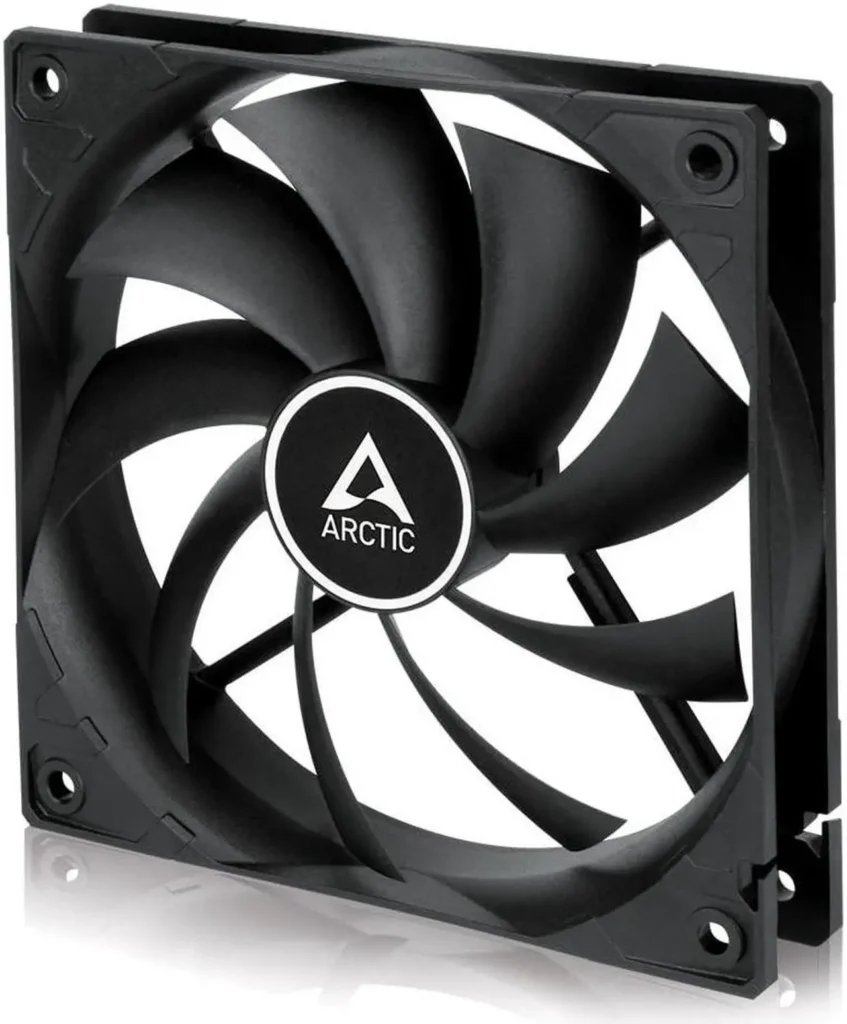
Mesh top exhaust with a filter: this depends on filter density. Light mesh panels are close enough to unrestricted that airflow fans are fine. Dense filters benefit from static pressure fans. Arctic F12 PWM ($29)
What the Specifications Mean
CFM (Cubic Feet per Minute) measures airflow volume. Higher CFM means more air moved per minute. Relevant for intake and exhaust in unrestricted positions.
mmH₂O (millimetres of water column) measures static pressure. Higher values mean the fan can push air through greater resistance without losing volume. Relevant for radiators and heatsinks.
dBA is noise level. For equivalent performance, lower is better. Static pressure fans tend to run louder than airflow fans at the same RPM because the blade geometry needed for pressure is less aerodynamically efficient acoustically. This is a trade-off worth accepting on a radiator, the thermal benefit outweighs the noise.
Practical Fan Recommendations by Position
For radiator positions, Noctua NF-A12x25 and NF-A14 iPPC are consistently the benchmark static pressure performers. Arctic P12 and P14 offer similar performance at significantly lower prices. The Arctic P fans are the recommendation for budget builds, genuinely competitive performance at around $10-15 per fan. Noctua NF-A12x25 ($59)

For open intake and exhaust positions, Noctua NF-A14 (airflow variant) and Be Quiet! Silent Wings 4 are the high-end choices. Arctic F12 and F14 cover the budget end without embarrassing themselves.
For ARGB builds where aesthetics matter alongside performance, Lian Li Uni Fan and Corsair iCUE Link QX series are competent airflow fans with strong visual output. Neither is a static pressure fan, use them for intake and exhaust, not for radiators in a high-TDP build. Lian Li Uni Fan SL120 ($29)

The Common Mistake
Buying a fan purely based on CFM for a radiator position, or purely based on noise level without checking whether it’s a static pressure variant. A fan with 90 CFM and 1.2mmH₂O running in front of a radiator will underperform a 70 CFM fan with 3.5mmH₂O in the same position.
Check both specifications before buying. Most reputable fan manufacturers label their fans as either SP (static pressure) or AF/F (airflow), if the product listing doesn’t specify, look up the static pressure spec. Under 2.0mmH₂O means it’s an airflow fan. Over 2.5mmH₂O is a static pressure unit.
Mixing Fan Types Is Fine
You don’t have to use the same fan everywhere. A common and effective configuration is static pressure fans on a front 360mm radiator, standard airflow fans at the rear exhaust, and mid-tier ARGB airflow fans at additional intake positions. Match the fan type to the position rather than trying to standardise across the build.