
The RTX 5060 launched on May 19, 2026. Within days the internet filled with breathless reviews and recommendation posts. This is not one of those. This is an honest breakdown of what the card actually is, what it actually costs right now, what its real limitations are, and whether you should buy it, wait, or look elsewhere.
The short answer is: it depends entirely on who you are and what you are buying it for. Read on for the full picture.
What the RTX 5060 Actually Is
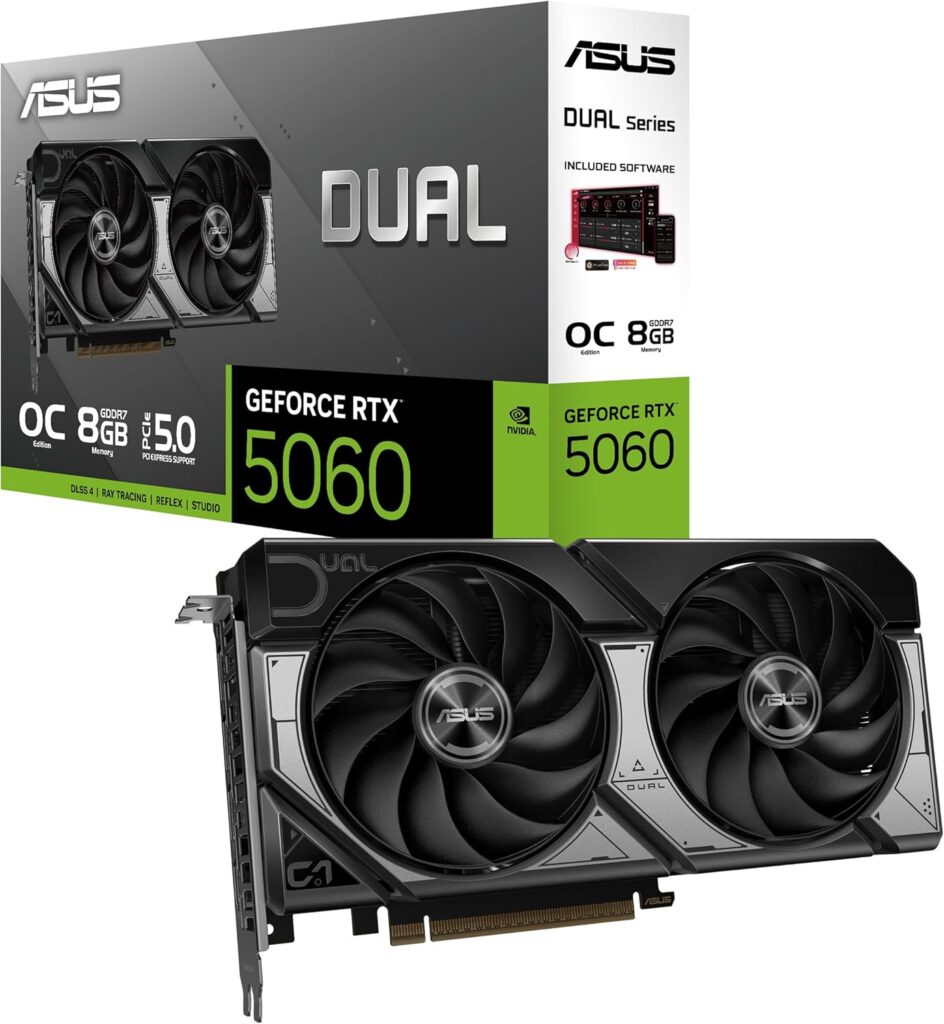
The RTX 5060 is Nvidia’s entry point into its Blackwell architecture, sitting below the RTX 5060 Ti in the 50-series lineup. It uses the GB206-250 die with 3,840 CUDA cores, 8GB of GDDR7 memory on a 128-bit bus, and a 145W TDP. MSRP at launch was $299 — the same price Nvidia launched the RTX 4060 at three years ago.
On paper the improvements over the RTX 4060 are real. GDDR7 memory delivers significantly higher bandwidth than the 4060’s GDDR6. The Blackwell architecture brings DLSS 4 with Multi Frame Generation, which is a genuine step forward for supported titles. Raw shader performance is meaningfully improved over the previous generation.
So far so good. Now for the parts most reviews gloss over.
The Elephant in the Room — 8GB of VRAM in 2026
This is the conversation the RTX 5060 cannot escape and should not escape.
In 2026, many modern games exceed 8GB of VRAM at high settings. When that threshold is crossed, performance does not just drop — it becomes inconsistent, with stuttering and frame pacing issues.
This is not a theoretical future concern. It is happening right now in titles that millions of people play.
VRAM requirements have exploded in recent years. The Last of Us Part I demands 11.2GB at 1440p high settings, Hogwarts Legacy allocates 10.5GB for high-quality textures, and Star Wars Jedi: Survivor peaks at 12.3GB VRAM usage, causing 1% lows to drop by 45% on 8GB cards.
The workaround Nvidia promotes is DLSS 4 with Multi Frame Generation — use AI upscaling and frame generation to compensate for lower native rendering. In supported titles DLSS 4 is genuinely impressive. But there are two problems with relying on it as a solution to a VRAM limitation.
First, Nvidia did not provide review units to publications before launch — a move that raised significant concerns about the company’s confidence in the card under independent testing conditions.
Second, DLSS Multi Frame Generation requires a solid base frame rate to work effectively. When a game is already stuttering because VRAM is exhausted, frame generation amplifies the problem rather than fixing it.
Reports from early 2026 indicate that Nvidia was specifically focusing on 8GB RTX 5060 series GPUs due to memory supply constraints — a commercially understandable decision that transferred the burden directly onto consumers.
What the RTX 5060 Actually Costs Right Now
MSRP is $299. That is the number Nvidia announced and the number in every headline.
The RTX 5060 is currently selling for $289-$350 on Amazon. One week after launch, the card is already 13% above its stated price. Supply is constrained and demand is pushing prices above MSRP immediately.
At $289-3350 the value calculation changes significantly. You are not buying a $350 card. You are buying a $350 card with 8GB of VRAM at a time when games are increasingly exceeding that limit.
The AMD Option — And the Driver Question You Deserve a Straight Answer To
Before we get to AMD’s current GPU offering, we need to address something directly — because it is the first thing anyone who considered AMD in the last few years is going to be thinking about.
AMD’s driver history has been genuinely problematic. This is not a myth or tribal console-war nonsense. It is documented, widespread, and drove a significant number of PC builders toward Nvidia who would not have otherwise left.
The RX 5700 XT at launch in 2019 was plagued by random black screens, game crashes, GPU timeouts and Wattman resets that took months to resolve properly. The RX 6000 series brought a new architecture but carried driver instability issues that lingered well into its lifespan — random driver timeouts, game-specific crashes, and the recurring Adrenalin software failures that made even basic tasks like alt-tabbing or monitor mode changes unpredictable. The RX 7900 XTX reference card had a well-documented thermal issue compounded by driver problems. People got frustrated, got Nvidia cards, and did not look back.
That reputation is real and it was earned. Anyone dismissing it has not spent enough time in PC building communities watching it play out in real time.
But here is where honesty requires updating the record.
By mid-2026, the picture with RDNA 4 is materially different. Independent testing found that Nvidia’s RTX 50-series drivers have actually been worse at launch — requiring multiple hotfixes that still plague the 50 series — while AMD’s RDNA 4 launch drivers were stable, with performance being the main area of improvement rather than crash fixes.
AMD has been actively optimising performance for its RDNA 4 cards through driver updates. Hardware Unboxed benchmarks found performance gains as high as 27% in some titles after driver updates, with an average 9% performance improvement at 1440p across 16 games. This is what the community has long called AMD’s “fine wine” approach — cards that improve meaningfully after launch as drivers mature.
One experienced reviewer who returned an RDNA 4 card due to a specific issue picked up an RX 9070 XT shortly after and found it rock solid — noting that AMD’s stability has been noticeably better since they introduced improved driver reporting tools.
That said, AMD drivers are not perfect in 2026 and anyone telling you otherwise is selling something. The current Adrenalin 26.5.1 release still lists known issues including intermittent crashes in RoadCraft on RX 9000 series, corruption in Satisfactory, and texture flickering when AMD Record and Stream is active. These are real, documented issues in specific titles.
The honest position in May 2026 is this: AMD’s driver situation with RDNA 4 is significantly better than the RDNA 1 and early RDNA 3 era that drove people away. It is not flawless. But the narrative that AMD drivers are categorically unreliable while Nvidia drivers are rock solid is no longer accurate — particularly given the RTX 50-series launch driver problems.
If you are someone who switched to Nvidia because of AMD driver frustrations three or four years ago, the situation has changed enough that dismissing AMD entirely is no longer the informed position it once was.
The Alternative You Need to Know About — RX 9060 XT
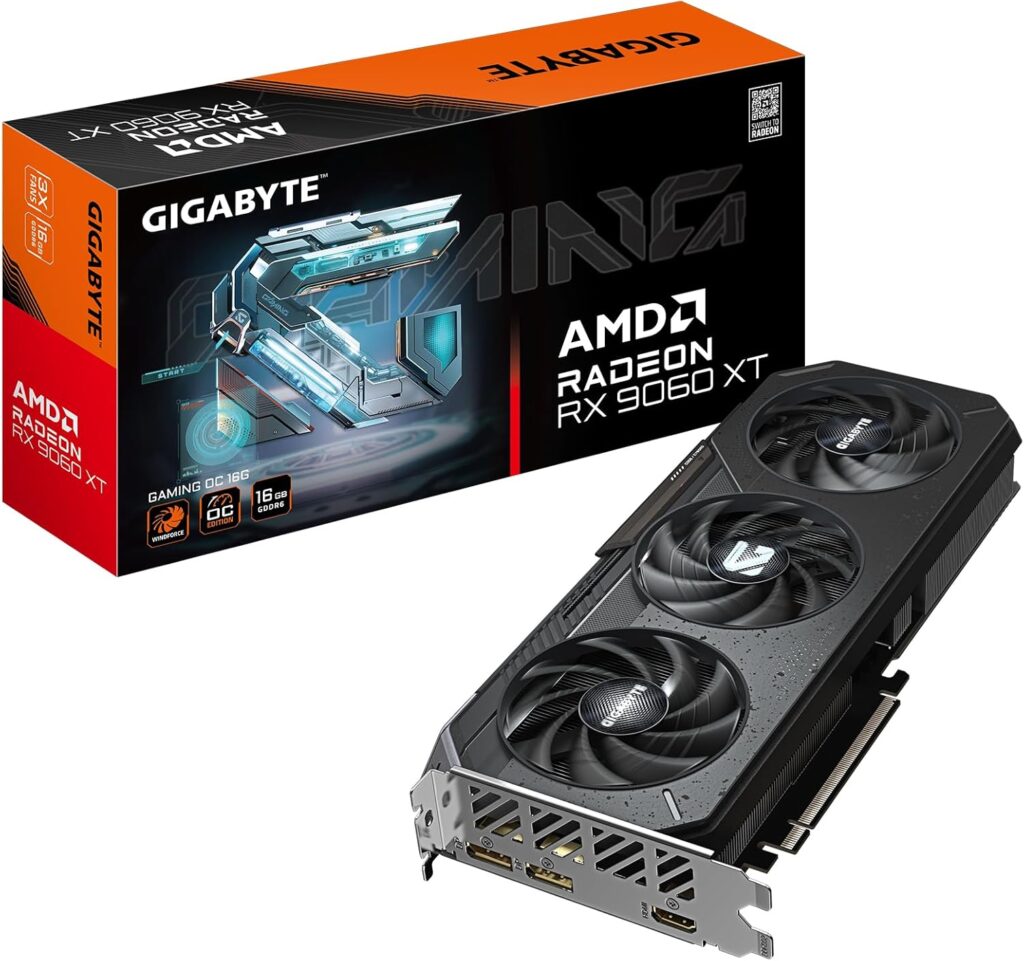
AMD launched the RX 9060 XT with pricing starting at $359-$500 for the 8GB model and $413-$470 for the 16GB model. The 16GB variant is the one that changes the conversation at this price point completely.
At 1080p the RX 9060 XT slightly outperforms the RTX 5060 in standard AAA games and esports titles. However when ray tracing is enabled the RTX 5060 leads significantly — around 29% higher frame rates in ray-traced workloads.
For most buyers the RX 9060 XT 16GB at $349-369 is more compelling than the RTX 5060 at its current above-MSRP pricing. You trade ray tracing performance and DLSS 4 for 16GB of VRAM and meaningfully better longevity in memory-intensive titles. Given that 8GB cards are already hitting limits in mainstream titles today, that trade-off increasingly favours AMD.
The honest breakdown:
- Ray tracing and DLSS 4 are priorities → RTX 5060 when at MSRP
- AAA gaming at high settings with longevity in mind → RX 9060 XT 16GB
- Primarily esports at 1080p → whichever is cheapest on the day you buy
Who Should Buy the RTX 5060 Right Now
Buy it if:
- You primarily play esports titles at 1080p — CS2, Valorant, Apex Legends, Fortnite
- You find it at or close to $299 MSRP
- Ray tracing and DLSS 4 are features you actively want
- You are upgrading from a GTX 10 or RTX 20 series card
Do not buy it if:
- You play modern AAA titles at high or ultra settings regularly
- You want the card to remain capable beyond two to three years
- You are seeing it priced above $320 — at that point the RX 9060 XT 16GB is the better value
- You game at 1440p — 8GB is already a real limitation at that resolution
Wait if:
- You own an RTX 3060 or better — the performance uplift does not justify the purchase at current above-MSRP pricing
- You are building new and can stretch $50 more — the RX 9060 XT 16GB at $349 is more future-proof
The Verdict
The RTX 5060 is a capable GPU that Nvidia has deliberately limited with 8GB of VRAM at a time when 8GB is demonstrably insufficient for a growing number of mainstream titles. The architecture is solid. DLSS 4 is genuinely impressive. The efficiency is good.
But the VRAM decision is not forgivable in 2026. AMD is shipping 16GB at the same price point. Nvidia chose not to — almost certainly to protect RTX 5060 Ti and higher-tier card sales.
Independent reviewers have been clear: prospective buyers should also look at AMD’s RX 9060 XT before committing to the RTX 5060. Given what we now know about AMD driver stability on RDNA 4, the old reflex of automatically choosing Nvidia for driver reliability is worth reconsidering.
If you find the RTX 5060 at $299 and you play esports titles primarily, it is a good buy. At $339 and above, with the RX 9060 XT 16GB available at $349-$373 and RDNA 4 driver stability in a meaningfully better place than it used to be, the RTX 5060 is genuinely hard to recommend over AMD at current market pricing.
Meta description: The RTX 5060 launched May 2026 at $299 but is already selling above MSRP. We break down the real performance, the 8GB VRAM problem, AMD’s improved driver situation in 2026, and whether the RX 9060 XT 16GB is the smarter buy right now.