
SpecClear earns a commission if you buy through Newegg links on this page, at no extra cost to you.
The AMD RX 9070 GRE launched globally on June 2 at $549. On paper that looks like a straightforward win with RDNA 4 architecture, 48 compute units, FSR 4.1 support, and a price tag that undercuts most of the competition. In practice, the story is messier than that.
AMD quietly raised the standard RX 9070’s price around the GRE launch, and as of October 2026 the cheapest 16GB RX 9070 on Newegg is about $700. That single move redrew the entire competitive picture. The GRE doesn’t fill a gap below the RX 9070 anymore — it fills the slot the RX 9070 vacated when AMD bumped it up by $70. And it does so with 4GB less VRAM and a significantly narrower memory bus.
Whether that trade-off makes sense depends entirely on what you’re building for, what resolution you’re targeting, and whether you care about ray tracing.
What the AMD RX 9070 GRE Actually Is
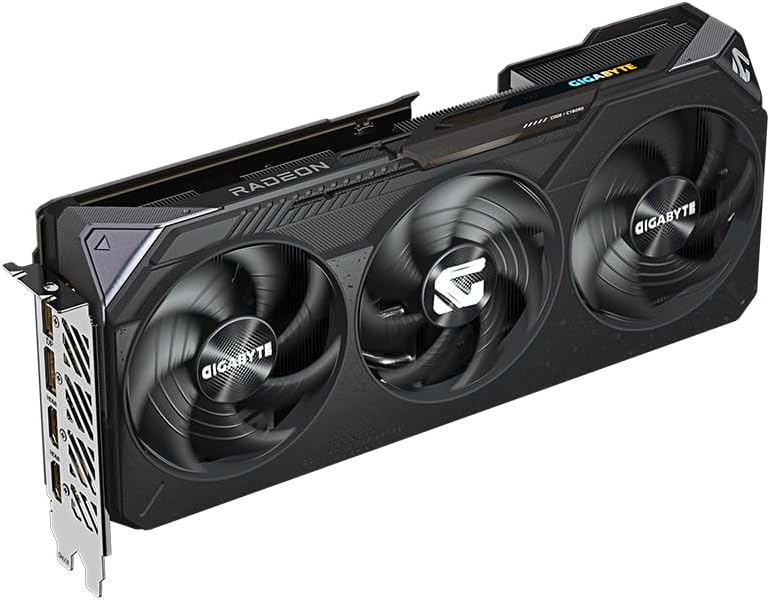
This isn’t a new GPU AMD launched the RX 9070 GRE in China in 2025 under the name “Golden Rabbit Edition.” It’s been available there for over a year the global rollout at Computex 2026 is AMD making an existing card available to buyers who couldn’t get it before and pricing it at the slot the standard RX 9070 used to occupy.
The silicon is Navi 48 is the same chip inside the RX 9070 and RX 9070 XT. What changes is how much of it AMD has enabled the GRE runs 48 compute units versus 56 on the standard RX 9070 and 64 on the XT. That’s a 14% cut from the 9070 and a 25% cut from the 9070 XT.
The memory configuration is where the real trade-off lives, 12GB of GDDR6 on a 192-bit bus delivering 432GB/s of bandwidth. The standard RX 9070 runs 16GB on a 256-bit bus a full 33% more bandwidth. That gap doesn’t show up much at 1440p in raster gaming It shows up hard at 4K and in ray-traced workloads.
Power draw is 220W identical to the standard RX 9070 despite the cut-down configuration. Boost clock runs up to 2.79GHz. PCIe 5.0 x16. DisplayPort 2.1a and HDMI 2.1b. Standard 8-pin power connectors no 12V-2×6 required.
The Numbers: What Independent Reviews Actually Found
AMD’s marketing materials claim the GRE is 22% faster than the RTX 5060 Ti 16GB across 40+ games. Those are AMD’s internal numbers on a Ryzen 7 9800X3D system. The independent reviews tell a more nuanced story.
Tom’s Hardware confirmed the GRE beats the RTX 5060 Ti 16GB at 1440p raster gaming roughly 21% faster on average. That checks out. The card is legitimately the better 1440p raster performer at comparable pricing when both cards are at MSRP.
At 4K, the picture changes. The 12GB VRAM ceiling starts to bite in demanding titles. In Cyberpunk 2077 at 4K with ray tracing, the GRE barely outperforms the RX 9060 XT 16GB a card that costs about $50 less on Newegg. At 4K path tracing, performance drops severely, falling behind AMD’s own previous-generation RX 7800 XT in some scenarios according to Neowin’s testing.
The thermal situation is genuinely good under full gaming load, the Sapphire Pulse variant tested by KitGuru peaked at 58°C. The fans were barely audible. After load, the card cooled to 30°C quickly. For a 220W card, that thermal performance stands out.
FSR 4.1 is present and running the full RDNA 4 native implementation not the INT8 port coming to RX 7000 cards. In Cyberpunk 2077 at 1440p with ray tracing enabled, FSR 4.1 Quality mode pushed AMD’s internal test from 45fps to 84fps. That’s a genuine uplift, not just a frame rate number on a slide. FSR 4 is doing real work here. It runs the same way on the AMD Radeon RX 9070 16GB.
The Pricing Problem
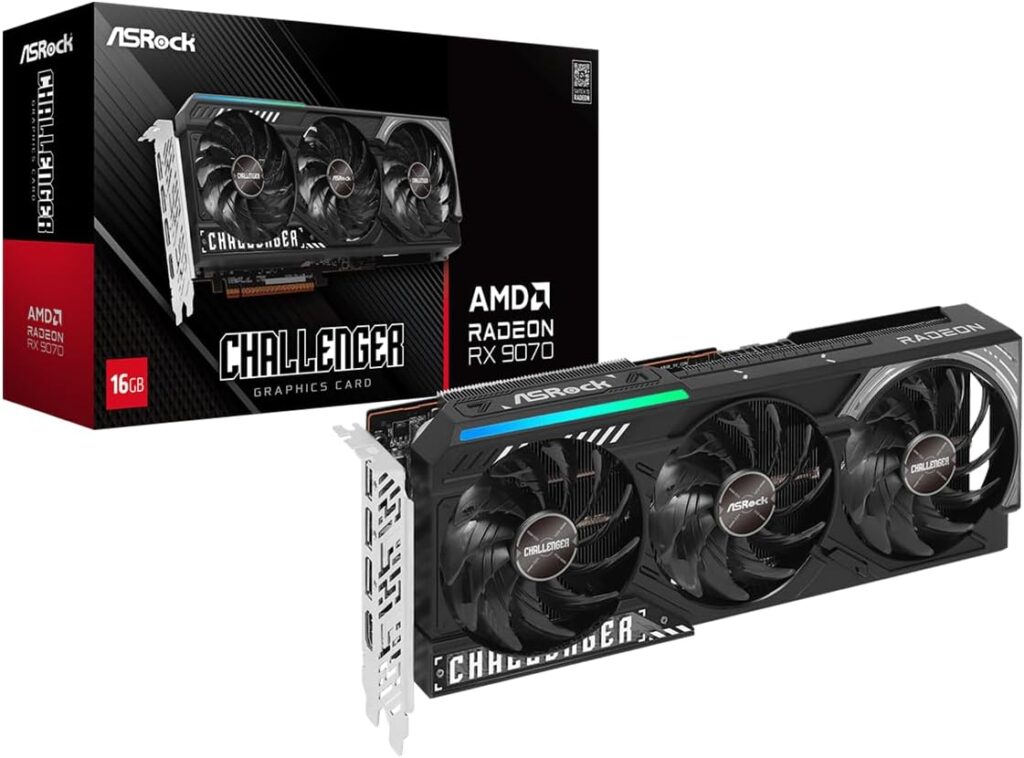
At $549 MSRP on launch day, the RX 9070 GRE looked like a strong value. The trouble is what surrounds it in the current market.
The standard RX 9070 (16GB, wider bus, more compute units) starts at about $700 on Newegg, while the cheapest GRE is about $570. That’s a gap of about $130. For that money you get 4GB of additional VRAM, 33% more memory bandwidth, and meaningfully better performance at 4K and in ray-traced workloads. If you’re anywhere near 4K gaming, it’s still worth paying. For 1440p raster gaming, the gap is now wide enough that the GRE is the better value.
The RX 9060 XT 16GB, at about $520 on Newegg, is the other pressure point. It’s 16GB at a lower price. The GRE is faster roughly 20-30% in raster gaming but the GRE has less VRAM. For 1080p and light 1440p gaming, the RX 9060 XT 16GB is hard to ignore.
The RTX 5060 Ti 16GB is about $800 on Newegg, roughly $230 more than the cheapest GRE. The GRE beats it in raster performance. The RTX 5060 Ti has DLSS 4 Multi Frame Generation, which the GRE can’t match. If frame generation is a priority, that matters. If raw raster performance at native resolution is the metric, the GRE wins.
The RTX 5070 is a different class. It’s faster in most workloads. It has the full Nvidia software stack. At about $830 on Newegg it also costs about $260 more than the GRE, which is a much bigger stretch than it was at launch.
PC Gamer put the GRE’s problem directly: it’s priced far too close to the superior RX 9070 for an unreserved recommendation. That was fair at launch, but with the RX 9070 now about $130 more on Newegg, the gap is wide enough to make the GRE a sensible buy.
Who Should Buy the RX 9070 GRE
Buy it if you’re gaming at 1440p, you’re not chasing ray tracing, and you find it for about $570 or less. At that price and use case, the raster performance is legitimately strong and the thermals are excellent. FSR 4.1 makes the 1440p experience better than the spec sheet suggests.
Don’t buy it if you’re gaming at 4K or planning to. The 12GB VRAM ceiling is real and it shows up quickly at that resolution with demanding settings. Spending about $130 more on the standard RX 9070 16GB is the right call. Here is the AMD Radeon RX 9070 16GB we would pick.
Don’t buy it if it’s selling much above $600. At that point the RX 9070 is less than $100 away, and the extra 4GB is worth it. Check current prices before purchasing GPU prices in 2026 don’t hold steady.
Don’t buy it as a ray tracing card it isn’t one, at 4K RT it falls behind cards that cost considerably less. If RT performance matters to your gaming, step up to the RX 9070 XT or cross over to Nvidia’s stack.
Available Models at Launch
No reference card the global launch came with custom boards from ASUS, Sapphire, and XFX. The Sapphire PULSE Radeon RX 9070 GRE Gaming OC 12GB and the ASUS PRIME RX 9070 GRE O12G are the two most widely available at launch. XFX released a Swift variant including a white version. Gigabyte’s Gaming OC model is also available on Newegg. Check current pricing the MSRP is $549 but board partner pricing varies.
The Bottom Line
The RX 9070 GRE is a competent 1440p card with strong raster performance, excellent thermals, and FSR 4.1 support. It’s also a card with 12GB of VRAM in a market where 16GB has become the sensible minimum, priced about $130 below a card with 16GB and better specs across the board.
At about $570 for 1440p raster gaming without ray tracing, it earns its place. Much above $600, or for any use case involving 4K or RT, look elsewhere.
SpecClear participates in affiliate programmes. When you purchase through links on this site we may earn a commission at no additional cost to you.–