
Nvidia just announced its first CPU. That’s not a typo.
For thirty years, Nvidia has made GPUs. You buy a CPU from Intel or AMD, then you buy a GPU from Nvidia to go with it. That’s how PC building works. It’s how it’s always worked.
The RTX Spark changes that completely. Not just for desktop PC builders — not yet, and possibly not ever. But it’s a significant enough shift that anyone who builds or buys PCs needs to understand what it actually is, what it can do, and whether it means anything for how you should be thinking about your next build.
Here’s the honest breakdown.
What the RTX Spark Actually Is
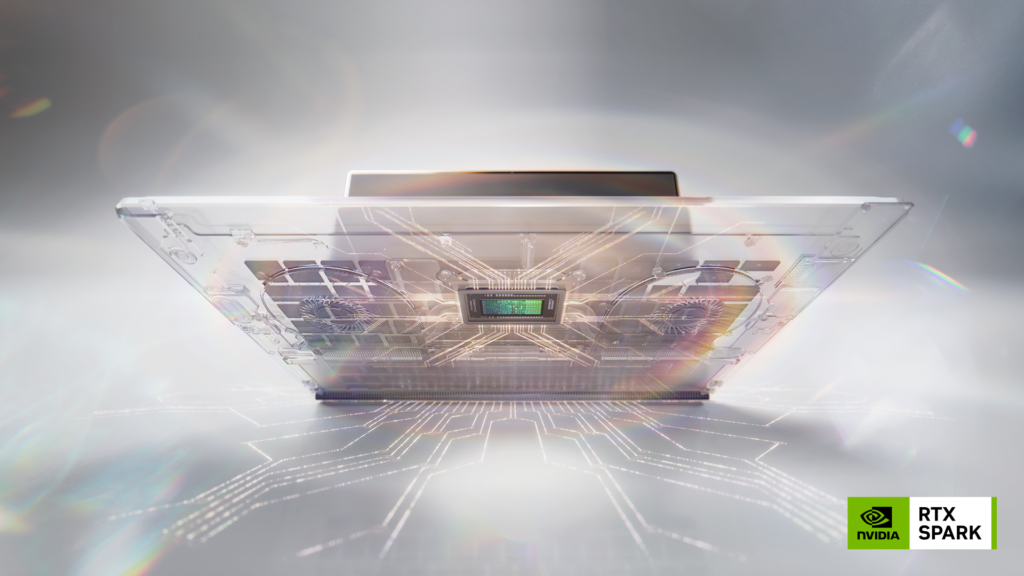
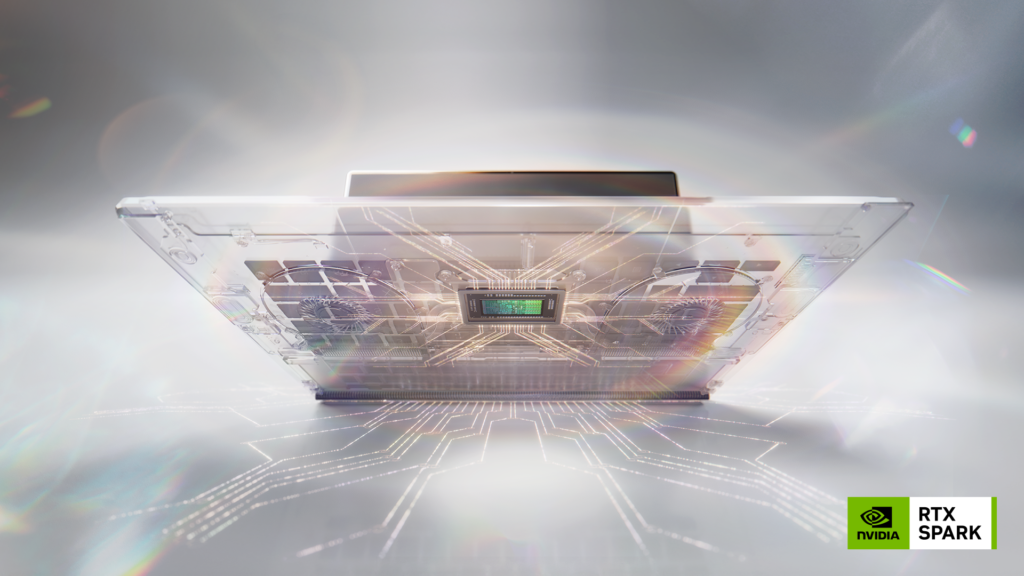
The Nvidia RTX Spark is a (system-on-a-chip) an SoC that means the CPU, GPU, memory, and NPU all live on a single piece of silicon rather than as separate components connected by a motherboard.
Announced at Computex 2026 on May 31, the RTX Spark combines a 20-core Nvidia Grace CPU with a Blackwell RTX GPU containing 6,144 CUDA cores, connected via Nvidia’s NVLink-C2C interconnect. The whole package is manufactured on TSMC’s 3nm process and supports up to 128GB of unified LPDDR5X memory.
Unified memory means the CPU and GPU share the same memory pool. There’s no discrete VRAM allocation. The GPU can access all 128GB if it needs to. For context, the RTX 5060 desktop card ships with 8GB of VRAM. The gap in addressable memory is not small.
Nvidia claims 1 petaflop of FP4 AI performance from the chip. That’s 1,000 teraflops. Apple’s M-series Neural Engine, by comparison, delivers 38 TOPS. RTX Spark is positioned to be dramatically faster at AI inference workloads than anything currently in a thin laptop.
This is also an ARM-based chip not X86 which distinction matters and we’ll come back to it.
What It Can Actually Do
Nvidia’s claimed performance figures for RTX Spark:
- Run 120-billion-parameter AI models locally on-device
- Handle 12K video editing
- Render 3D scenes larger than 90GB
- Push AAA gaming above 100fps at 1440p
That last claim needs context. The 1440p gaming performance comes with DLSS 4.5 and Frame Generation enabled on Nvidia’s AI-assisted upscaling and frame interpolation. It’s not native 1440p rendering at 100fps. That said, DLSS 4.5 is genuinely good, and the gaming performance is positioned as comparable to an RTX 5070 laptop GPU.
The 5070 laptop GPU is a capable card it’s not a desktop RTX 5070 laptop GPUs run at significantly lower power limits than their desktop equivalents. But for a thin laptop running everything from a single integrated chip, the performance numbers are impressive if they hold up in real-world testing. First devices are expected around October 2026, so broad independent reviews are still thin.
Adobe is doing a full architectural rebuild of Photoshop and Premiere Pro to support RTX Spark, with claimed performance improvements of up to 2x for AI and graphics workloads. Blackmagic Design, Blender, CapCut and Unreal Engine are also confirmed as optimised partners.
The ARM Question — Will It Run Everything?
This is the real concern for anyone considering an RTX Spark device, and it’s worth being direct about.
RTX Spark runs Windows on ARM, not Windows on x86. The vast majority of PC software including most games originally was written for x86. Running x86 software on an ARM chip requires emulation.
Microsoft’s emulation layer, called Prism, handles this. Jensen Huang claimed at Computex that RTX Spark will run “every Windows app ever made.” That’s a bold statement. The honest version is more nuanced.
Prism has improved significantly and handles most x86 apps well. Microsoft has confirmed it’s optimised Prism specifically for RTX Spark’s architecture. For everyday productivity software, creative apps, and the majority of mainstream games, compatibility should be fine.
The sticking points are anti-cheat software and older games with kernel-level protection. Nvidia says it’s working directly with game developers to ensure anti-cheat compatibility. Alan Wake 2 was demonstrated running natively on ARM at Computex. But until devices ship and users start testing their specific game libraries, the “runs everything” claim carries an asterisk.
The Nvidia Spark vs a Desktop PC Build

This is the question SpecClear’s audience actually needs answered: does this change anything about building a desktop PC?
No. Not right now.
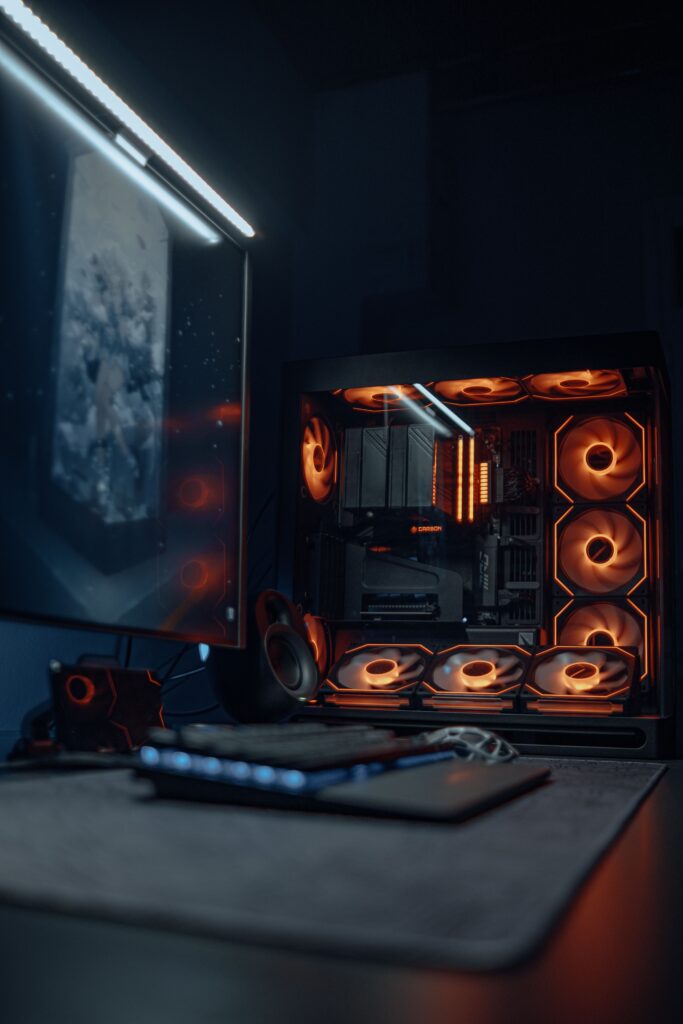
RTX Spark is aimed at laptops and compact desktop mini-PCs. It’s a mobile platform. The GPU performance, while impressive for a thin device, is in the RTX 5070 laptop class — not desktop class. A desktop RTX 5070 running at full power draws significantly more and performs significantly better than any laptop variant.
More importantly, RTX Spark systems still lack firm MSRPs; early OEM chatter puts entry configs nearer ~$1,800+, climbing considerably for high-memory builds. First N1X machines are expected to start shipping around October 2026. You can build a capable gaming desktop with an RTX 5060 and a Ryzen 5 7600 for less, with better gaming performance, a full-size GPU you can replace, and no ARM compatibility questions to worry about.
For desktop PC builders, the RTX Spark is not a reason to wait, reconsider, or change your build plans. It’s a different product category solving different problems.
Who the RTX Spark Is Actually For
The honest answer is that RTX Spark is primarily an AI workstation in a laptop form factor. The gaming capabilities are real, but gaming is not why this chip exists.
The target buyer is someone who needs to run large AI models locally for developers, researchers, creative professionals doing heavy AI-assisted workflows in a thin, portable device that doesn’t need to be plugged in constantly. The 128GB unified memory pool is the hardware specification that matters most for these workloads. No GPU on the market at any price gives you that memory capacity in a consumer device.
If you’re a PC gamer who builds desktops, this isn’t your product. If you’re a creative professional or AI developer who works on a laptop and has been frustrated by VRAM limitations and cloud dependency, fall 2026 is worth watching closely.
Confirmed launch partners include ASUS, Dell, HP, Lenovo, Microsoft Surface and MSI, with Acer and Gigabyte models following. No confirmed pricing yet beyond the expectation of a premium entry point.
What It Means for PC Building Long-Term
This is the more interesting question, and it’s worth being honest that nobody knows the answer yet.
PCWorld noted that RTX Spark is the most powerful boost ARM has ever received in the consumer PC space. If Nvidia gets broad software compatibility right will be including including games and it creates genuine competition for x86 in the laptop market for the first time. That matters because it pressures Intel and AMD to compete differently, which historically means better products and better value for desktop builders.
ARM doesn’t threaten desktop PC building in the near term. Intel and AMD still own that market entirely. But if RTX Spark succeeds in laptops the way Apple Silicon succeeded in Macs, it reshapes how the industry thinks about what a PC is.
For now, if you’re building a gaming desktop: nothing changes. Keep building with x86, keep buying discrete GPUs, and watch what happens when RTX Spark devices actually ship and reviewers get hold of them.
That’s when the real conversation starts.
SpecClear participates in affiliate programmes. When you purchase through links on this site we may earn a commission at no additional cost to you.