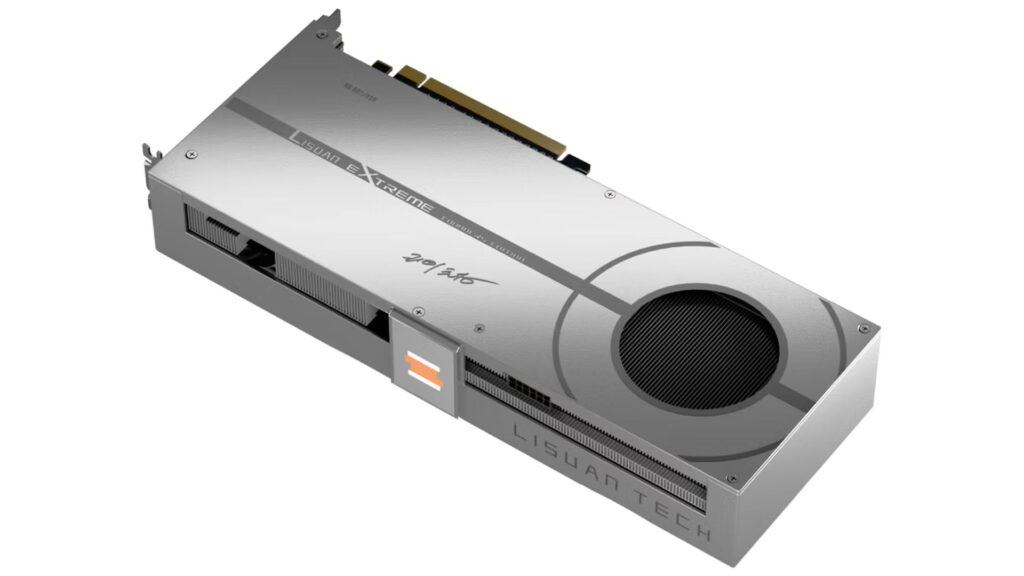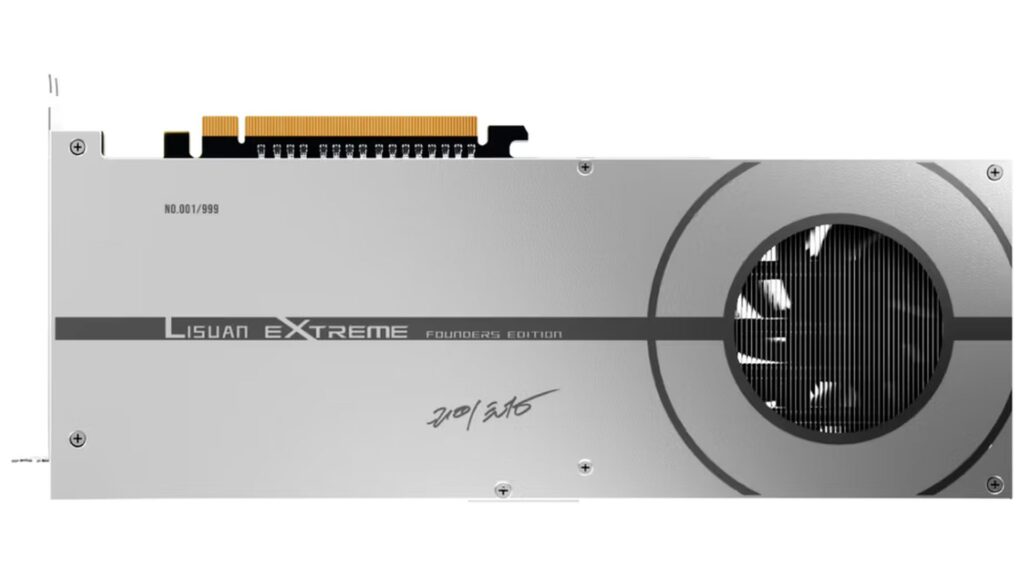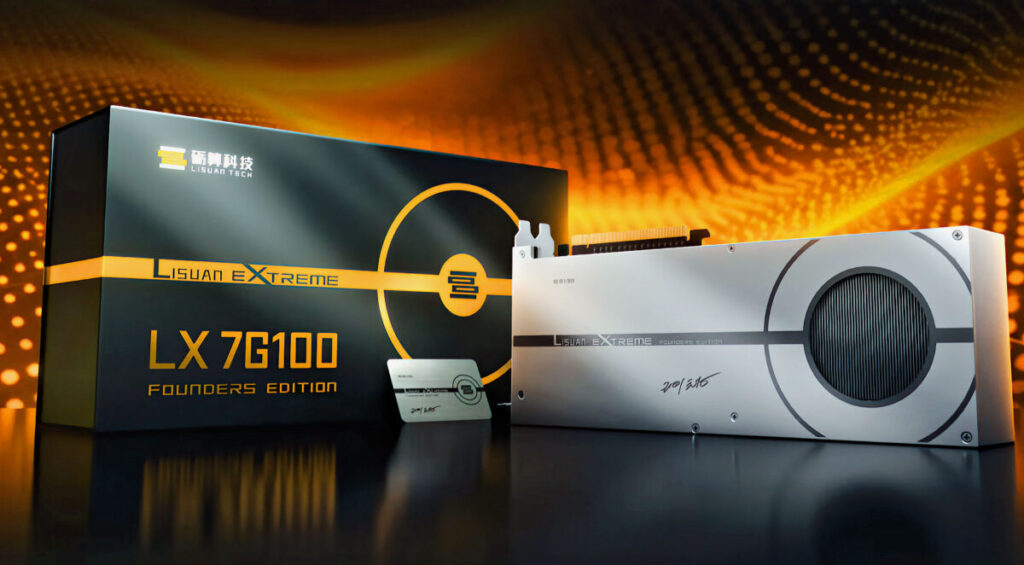
Four companies have ever built a GPU that passes Microsoft’s WHQL certification. Nvidia. AMD. Intel. And now, a Chinese startup most people outside Asia had never heard of until this year.
That’s the actual headline here. Not the benchmark numbers — though we’ll get to those, and they’re complicated. The headline is that Lisuan Technology has done something nobody else has managed to do in three decades of GPU development. They built a graphics card from scratch, wrote their own drivers, developed their own architecture, and got it certified by Microsoft as a legitimate Windows GPU.
Whether you’d want to buy one is a different question entirely.
Who Makes the Lisuan LX 7G100?
Lisuan Tech is a Chinese semiconductor company that’s been working on GPU architecture quietly for several years plus They built the Lisuan LX 7G100 graphics card butThey’re not a household name in the West, but within China’s domestic chip industry they’re one of the more serious attempts to build an independent GPU stack — meaning their own silicon design, their own driver software, their own everything.
The context matters here. US export controls restrict the sale of advanced chip manufacturing equipment and high-end GPU hardware to China. Nvidia’s H100 and H800 AI accelerators are effectively blocked. That’s created significant pressure on Chinese companies to develop domestic alternatives, both for AI workloads and for consumer gaming. Lisuan is one of the companies trying to fill that gap.
Their product lineup has four cards: three professional and AI-focused variants (the LX Ultra, LX Pro, and LX Max), and one gaming card — the LX 7G100. The gaming card is the one getting attention right now, and it’s the one this article covers.
The Specs

The LX 7G100 is built on the 7G106 GPU, fabricated on TSMC’s 6nm process. Here’s the full spec sheet:
| Specification | Detail |
|---|---|
| GPU Architecture | TrueGPU (proprietary) |
| Process Node | 6nm (TSMC) |
| Shading Units | 6,144 |
| Texture Units | 192 TMUs |
| Render Outputs | 96 ROPs |
| Memory | 12GB GDDR6 |
| Memory Bus | 192-bit |
| Memory Bandwidth | 384 GB/s |
| Interface | PCIe 4.0 x16 |
| TDP | 225W |
| Power Connector | 1x 8-pin |
| Display Outputs | 4x DisplayPort 1.4a |
| API Support | DirectX 12, Vulkan 1.3, OpenGL 4.6, OpenCL 3.0 |
| Ray Tracing | No hardware support |
A few things stand out immediately. 12GB GDDR6 on a 192-bit bus is a respectable memory configuration — the RTX 5060 ships with 8GB, which is why that card has attracted criticism. The 225W TDP on a single 8-pin connector is manageable. Four DisplayPort 1.4a outputs support up to 8K60 HDR with DSC. No HDMI port is an unusual choice that will require an adapter for most monitor setups.
The absence of hardware ray tracing is notable. Nvidia has had it since the RTX 20-series in 2018. AMD added it with RDNA 2 in 2020. Lisuan says ray tracing is coming in their second-generation GPUs. It’s not the card’s biggest problem, but it’s a gap.
The WHQL Milestone — Why It Actually Matters
Before getting to gaming performance, it’s worth understanding why the WHQL certification is genuinely significant.
WHQL — Windows Hardware Quality Labs — is Microsoft’s driver certification program. Getting it means your GPU driver has passed a rigorous compatibility and stability testing process. It means Windows Update can distribute it. It means enterprise IT departments can deploy it without special exceptions. It means the card works properly in the Windows ecosystem.
Only three companies had ever achieved this for a GPU: Nvidia, AMD, and Intel. Lisuan is now the fourth. For a company building its first consumer GPU under significant manufacturing restrictions, that’s not a footnote. It’s the thing that separates a real GPU company from a prototype lab.
The WHQL driver (v29.0.2260.76) shipped on May 18, 2026. Lisuan also released a 40-game recommended settings guide to help early buyers get playable results — which tells you something about where the driver stands, but it’s a legitimate thing to do for a launch product.
Gaming Performance — The Honest Numbers
This is where the conversation gets complicated. Lisuan claimed RTX 4060-class performance ahead of launch. That claim was based on synthetic benchmarks. Real-world gaming numbers from independent reviewers tell a different story.
All results below are at 1080p from independent testing published in May 2026:
Cyberpunk 2077 (FSR3 Quality + Frame Generation)
- LX 7G100: 88 fps
- RTX 4060: 232 fps
- Intel Arc B580: 243 fps
- RX 6600 XT: 200+ fps
Black Myth: Wukong
- LX 7G100: 56 fps
- RTX 4060: 115 fps
Forza Horizon 5
- LX 7G100: 48 fps (Low preset)
The Witcher 3
- LX 7G100: 57 fps
Elden Ring
- LX 7G100: 80 fps
GTA V
- LX 7G100: 150 fps
Dota 2
- LX 7G100: 182 fps
The pattern is clear. Older, less demanding titles run fine. Modern, GPU-heavy games expose a significant performance deficit. In Cyberpunk 2077 the RTX 4060 delivers nearly three times the frame rate. In Black Myth: Wukong it’s more than double.
In 3DMark synthetic benchmarks the LX 7G100 sits roughly around RTX 3060 territory. The RTX 3060 launched five years ago at $329.
The gaming performance lands it somewhere between an RTX 3060 and an RTX 3060 Ti depending on the workload. That’s a five-year-old performance tier. The card sells for $480.
The Software Problem

The hardware isn’t the main story here. The software is.
Every reviewer reported the same issues. The driver control panel has almost no usable options — there’s no equivalent of Nvidia’s Control Panel or AMD’s Adrenalin suite. Overclocking settings reset after every reboot. Frame pacing is inconsistent, causing noticeable stuttering in several titles even when average frame rates look acceptable. Monitoring support is limited.
This is exactly what Intel went through with Arc.
The Arc A770 launched in October 2022 with genuinely competitive hardware on paper — but DX11 game performance was terrible at launch, and it took 18 months of intensive driver work before the card became something most people would recommend without heavy caveats. The hardware was capable. The software wasn’t ready.
Lisuan is in the same position, except they’re starting from a better compatibility baseline than Intel did. The LX 7G100 runs modern DX12 games at launch without requiring months of driver patches just to boot. That’s already an improvement over Moore Threads’ MTT S80, which needed extensive post-launch driver work before it could even run many titles.
Driver maturity is measured in years, not months. The card that exists today is not the card that will exist in 12 months once the driver team has iterated on real-world usage data.
The Price Problem

$480 for this card is hard to defend on pure gaming merit. That’s the honest position.
At $480 you’re competing directly with:
- RTX 5060 Ti: significantly faster, hardware ray tracing, DLSS 4
- Used RTX 3080: comparable or better performance, 10GB VRAM
- RX 9060 XT 16GB: faster, twice the VRAM, mature drivers
- Intel Arc B580: faster, $100 cheaper, DirectX 12 optimised
The LX 7G100 doesn’t beat any of these. Not even close. In several benchmarks a used RTX 3080 at $160-$180 second-hand delivers comparable or better performance.
The 30,000-unit Founders Edition sold out at $480. That demand came primarily from Chinese buyers motivated by factors beyond pure performance — supporting domestic tech, concerns about long-term hardware access under export controls, and genuine enthusiasm for a homegrown GPU. Those are legitimate reasons to buy something. They just don’t translate into a recommendation for an international buyer with no such constraints.
Who Should Consider the LX 7G100

Nobody outside China can currently buy one, so this section is partly forward-looking. But it’s worth being direct about who this card makes sense for:
It makes sense if:
- You’re in China and your existing card has died, you need something now, and used card availability is limited in your market
- You want to support domestic Chinese semiconductor development and performance is a secondary consideration
- You’re a developer or researcher who needs to test applications on a non-Nvidia, non-AMD, non-Intel GPU stack
- You’re genuinely interested in where this company goes next and want early access to the platform
It doesn’t make sense if:
- Gaming performance per dollar is your primary concern
- You want hardware ray tracing
- You need a mature driver ecosystem with proper monitoring and control panel tools
- You’re building outside China where alternatives are freely available
The Bigger Picture
Lisuan’s LX 7G100 is more impressive as a milestone than as a product. That’s not a dismissal — milestones matter, and this one is genuinely significant.
China has been trying to build a competitive domestic GPU for years. Earlier attempts like Moore Threads’ MTT S80 and various Jingjia Micro products were nowhere close to mainstream gaming compatibility. The LX 7G100 runs Cyberpunk 2077. Poorly, and at a fraction of the frame rate you’d get from a three-year-old Western GPU, but it runs it. That’s not nothing.
The trajectory is what to watch. Lisuan’s first commercial sample a year ago performed like a 13-year-old GTX 660 Ti. The retail LX 7G100 performs like a five-year-old RTX 3060. If that rate of improvement continues, their second-generation card is worth paying serious attention to.
The Intel Arc parallel holds here too. The Arc A770 that launched in 2022 was a frustrating product that most reviewers couldn’t recommend without qualifications. The Arc B580 that launched in late 2024 was genuinely competitive and sold out repeatedly. Two years and one generation closed the gap almost entirely.
Lisuan’s second GPU generation, with promised hardware ray tracing and presumably a more mature driver stack, is the product that will tell you whether this company is building toward something real or not.
For now, the LX 7G100 is China’s first credible gaming GPU. Not its best. Not a competitive buy for most people reading this. But a real product from a real company that just joined a very short list.
SpecClear participates in affiliate programmes. When you purchase through links on this site we may earn a commission at no additional cost to you.