
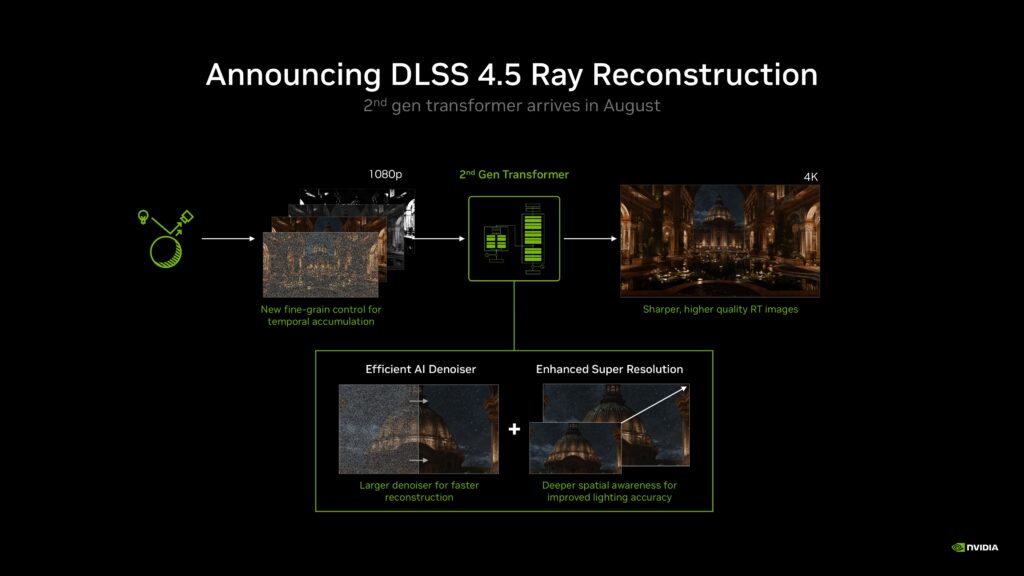
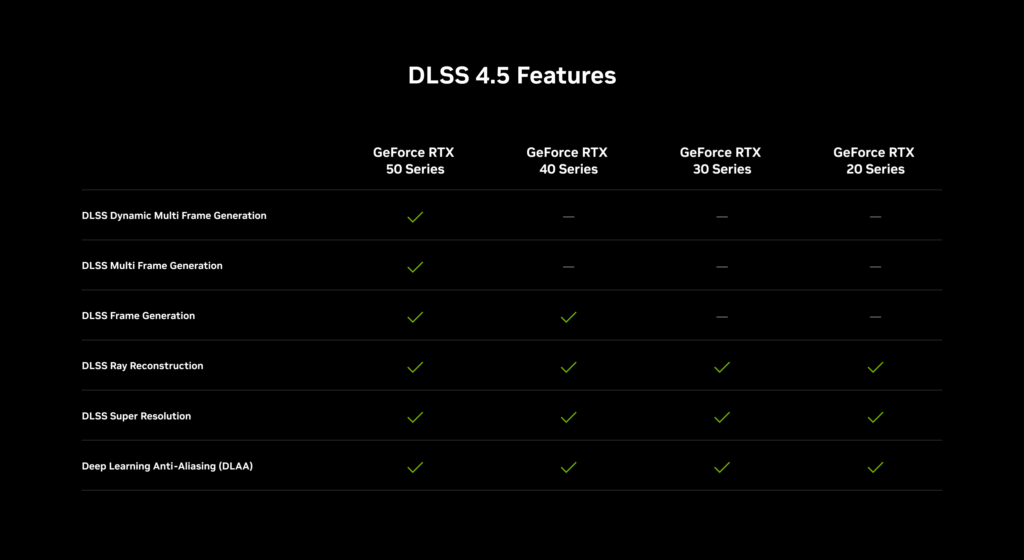
DLSS 4.5 Ray Reconstruction launches next month. If you own any GeForce changesTX GPU from an RTX 2060 through to a brand new RTX 5090 this update applies to you. That’s the first important thing to understand. Unlike DLSS 5, which requires RTX 50 series hardware, Ray Reconstruction 4.5 works on every RTX generation without exception.
The second important thing: this is not a minor patch. The 2nd generation transformer model powering it delivers 35% more compute capability and processes 20% more parameters than the previous version. In ray-traced and path-traced games, the image quality improvement is substantial. Whether that matters for how you game depends on what ray tracing settings you actually use.DLSS 4.5 and DLSS 5 Explained
What Ray Reconstruction does — the quick explanation
Ray tracing renders lighting by simulating the paths of individual light rays as they bounce around a scene. The result is physically accurate shadows, reflections, and global illumination that rasterised lighting can’t replicate. The problem is that full ray tracing is extraordinarily computationally expensive rendering every ray’s contribution to every pixel is impractical in real time even on the fastest consumer GPUs.
The solution is denoising. Rather than rendering every ray path completely, the GPU renders a portion of them and uses a denoiser to reconstruct what the missing rays would have produced. Early denoising was noisy and produced visual artefacts ghostly trails on moving objects, flickering in specular reflections, unstable particle effects that shimmered rather than held steady.
DLSS Ray Reconstruction replaces traditional hand-coded denoisers with an AI model trained on ray-traced and path-traced reference images. The model has deeper context about what ray-traced lighting should look like than any hand-written denoiser, which means it reconstructs missing detail more accurately and produces fewer artefacts. The result is cleaner ray tracing at the same performance cost.
What’s new in the 4.5 version specifically

The DLSS 4.5 Ray Reconstruction model introduces several concrete improvements over the previous version.DLSS 5 What It Is and Why It’s Controversial
The 35% more compute capability and 20% more parameters translate to deeper spatial awareness across every scene. The model more intelligently uses game engine pixel sampling and motion data to understand what each pixel should look like rather than pattern-matching from general training data. In practice this shows up as improved lighting accuracy in complex scenes particularly in areas with multiple light sources, caustics, or high-frequency detail in reflective surfaces.
Temporal stability is significantly improved. One of the most visible problems with earlier ray reconstruction implementations was ghosting on moving objects a faint trail of the object’s previous position that persisted for a frame or two. The 4.5 model addresses this directly, with Nvidia’s comparison footage showing dramatic reductions in ghosting in Pragmata’s laser effects and similar high-frequency moving elements.
Particle effects specifically receive attention in the 4.5 update. Ray-traced particle effects smoke, fire, sparks are notoriously difficult to reconstruct because they move unpredictably and their interaction with lighting changes rapidly. The 4.5 model shows improved stability on particle systems, which shows up most clearly in games like DOOM: The Dark Ages where particle effects are dense and fast-moving.
The expanded training dataset is the foundation of most improvements. A larger, more diverse training set gives the model better awareness of edge cases lighting configurations it hasn’t specifically seen before which reduces the frequency of unexpected artefact appearances in unusual scenes.Nvidia App and AMD Adrenalin Gaming Settings Guide
The 27 games launching with support
At launch in August 2026, DLSS 4.5 Ray Reconstruction will be supported in 27 games. Nvidia hasn’t published the complete final list but confirmed titles include Cyberpunk 2077, Alan Wake 2, DOOM: The Dark Ages, and Pragmata. These are among the most ray-tracing-intensive titles available if Ray Reconstruction 4.5 performs well in Cyberpunk 2077 at Overdrive RT mode and Alan Wake 2 at full path tracing, those results will be representative of what the technology delivers across the broader launch list.
Support comes in two ways. Some games will have native in-game integration, meaning you enable it through the game’s graphics settings the same way you’d enable any other DLSS feature. Others will be accessible through the DLSS Override feature in the Nvidia App, which lets you apply a newer DLSS model to any game that supports an older version without waiting for a developer update. If you own a supported game and install the August driver update, you’ll be able to enable Ray Reconstruction 4.5 through the Nvidia App regardless of whether the game itself has been updated.
The Blender integration
Nvidia confirmed DLSS 4.5 Ray Reconstruction is coming to Blender 5.3, releasing alongside the DLSS update this fall. For 3D artists using Blender’s Cycles renderer, the integration replaces slower CPU-based denoisers with the AI reconstruction model. The result is near-final render quality visible in the interactive viewport rather than having to wait for a full render pass to see how lighting looks. For anyone doing 3D work alongside gaming on the same PC, this is a meaningful productivity improvement that arrives alongside the gaming benefits.
How to enable it when it launches
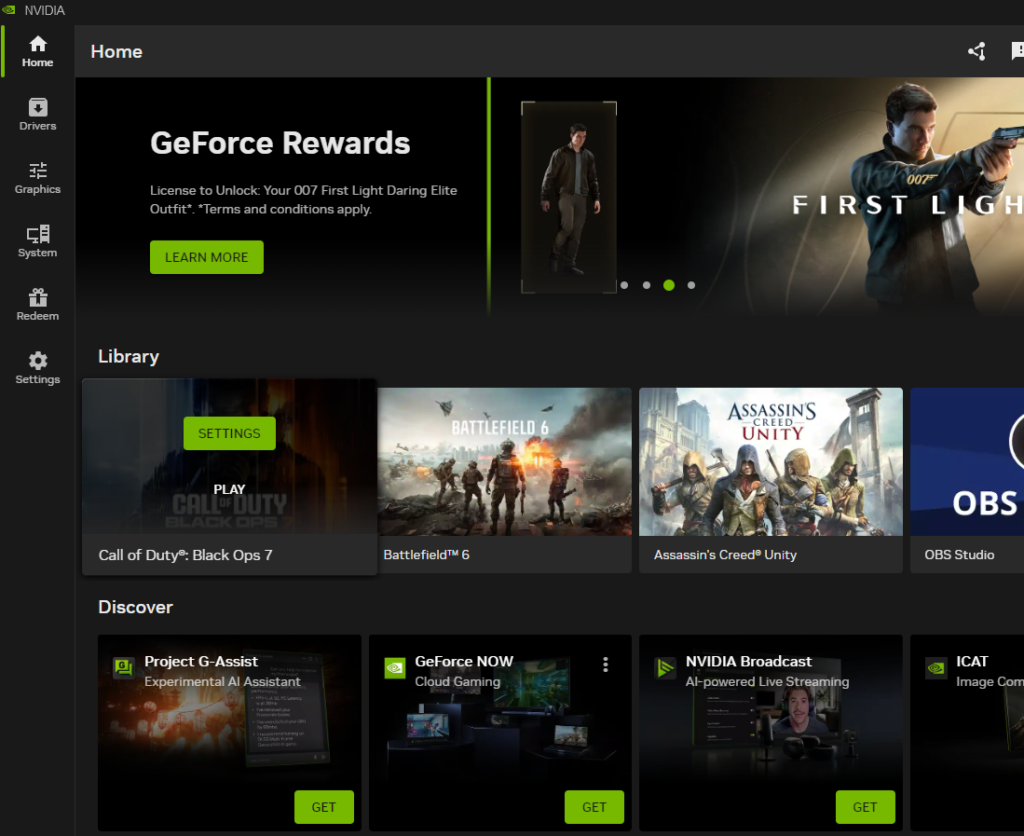
When the August 2026 driver update arrives, the process is the same as enabling previous DLSS features. Open the Nvidia App, navigate to the game in question, and look for the Ray Reconstruction option under the DLSS settings. For games without native support, the DLSS Override settings let you force the newer model.
If you’re not already using the Nvidia App rather than GeForce Experience, this is a good time to switch. The Nvidia App consolidates DLSS override controls, driver updates, and per-game performance settings in one place and is the recommended tool for managing DLSS features going forward.
Who benefits most

RTX 30 and 40 series owners benefit most from this update in relative terms. The RTX 50 series already has access to DLSS 4.5 Super Resolution and Multi Frame Generation features that don’t apply to older cards. Ray Reconstruction 4.5 is the one major DLSS 4.5 improvement that applies universally. An RTX 3080 owner running Cyberpunk 2077 with ray tracing enabled gets the same model quality improvement as an RTX 5090 owner. The computational requirements scale to the hardware available, but the model itself doesn’t change between GPU generations.
For competitive players who keep ray tracing off for maximum frame rates, this update is irrelevant. RT Off is still RT Off and frame rates don’t change when you’re not using ray tracing. Ray Reconstruction only applies when ray tracing is enabled.
For anyone who plays Cyberpunk 2077 at any RT setting, Alan Wake 2 with path tracing, or any of the other confirmed launch titles with ray tracing enabled, August is worth putting in the calendar. The update is free, requires no new hardware, and the improvement in ray-traced image quality from the 2nd generation model is substantial.