
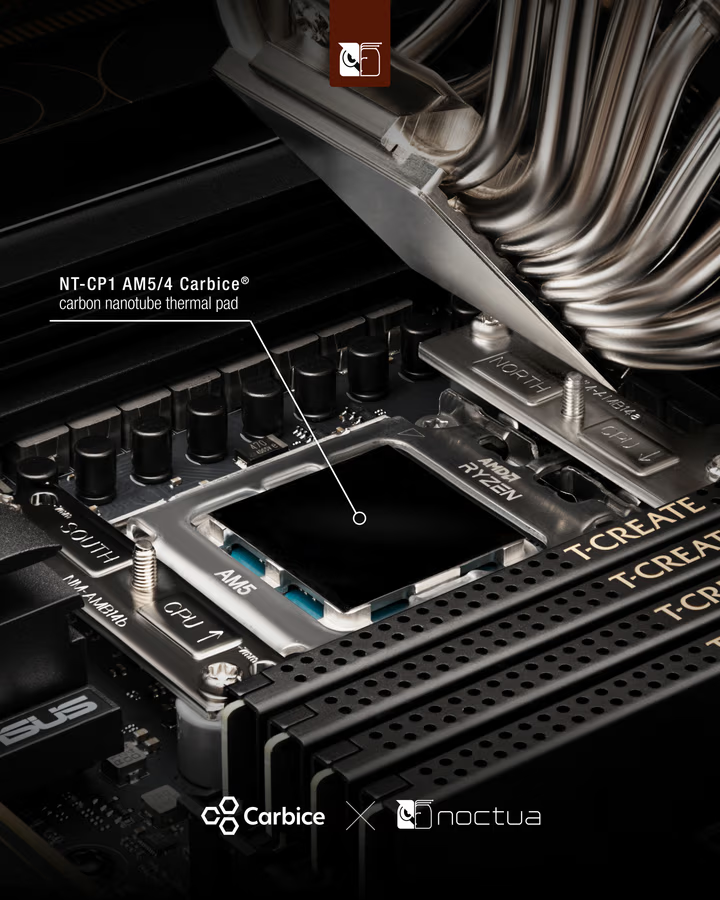
Thermal paste has been a maintenance item in PC building since the beginning. You apply it, it works, it gradually degrades over years of heat cycling as the paste dries, cracks, or pumps out from the die centre, and eventually temperatures creep up enough that you open the case and repaste. It’s been the accepted rhythm of PC ownership for decades.
The Noctua NT-CP1, launching September 2026, is a direct challenge to that rhythm. It’s a pre-cut carbon nanotube thermal pad that replaces paste entirely and unlike paste, it’s designed to get better with use rather than worse. Here’s what that actually means and whether it’s worth buying.Air Cooler vs AIO CPU Cooler 2026
Where the technology comes from
Carbon nanotube thermal interface materials are not new. They’ve been used in satellites, aerospace hardware, and critical industrial applications where reliability over years matters more than any other consideration. You can’t repaste a satellite. The thermal interface has to work correctly for the entire mission life without degradation.
Carbice, an Atlanta-based company founded by Dr. Baratunde Cola from Georgia Tech in 2011, has supplied IP90 carbon nanotube pads to those industries for years. The technology is proven in environments considerably more demanding than a gaming PC. Its entry into the consumer market isn’t speculative engineering it’s an established aerospace material being adapted for a new application.
AMD chose the Carbice Ice Pad as the included thermal interface material with the relaunched Ryzen 7 5800X3D 10th Anniversary Edition in June 2026 the first major retail CPU to ship with a carbon nanotube TIM rather than a tube of paste. The NT-CP1 is the standalone retail version of that same technology, distributed exclusively by Noctua from September 2026.
How carbon nanotube pads actually work
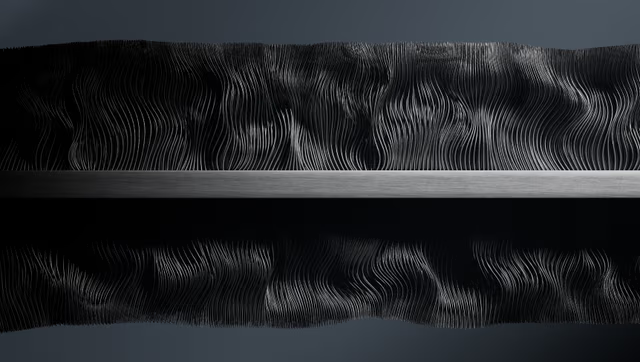
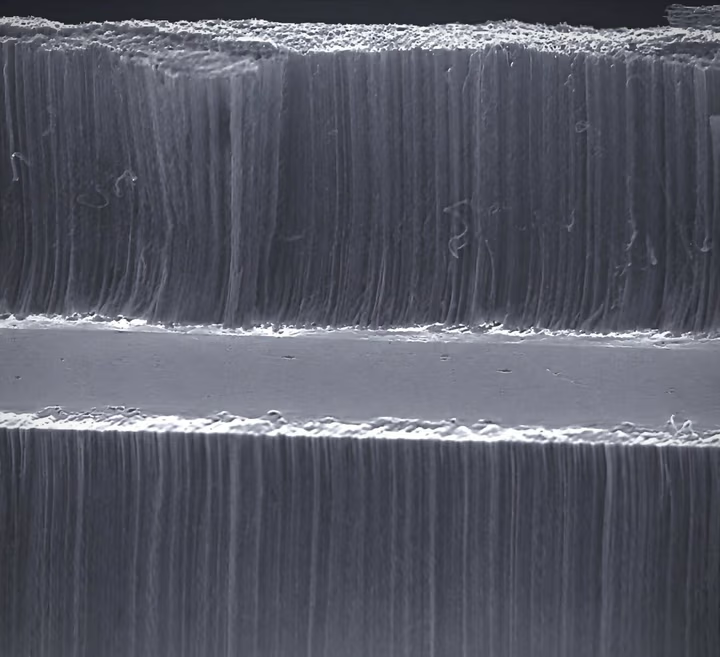
The structure is what separates the NT-CP1 from conventional graphite pads and paste. Vertically aligned carbon nanotube forests are anchored to a thin aluminium backbone, with a nanoscale polymer coating across each surface face. The alignment is the key detail the nanotubes run perpendicular to the CPU’s integrated heat spreader, which is exactly the direction heat needs to travel from the die to the cooler base plate.
Individual carbon nanotubes conduct heat along their axis at roughly nine times the rate of copper, making them among the most thermally conductive materials known. The practical benefit arrives through a mechanism that’s different from anything else in the thermal interface market.How to Clean Your PC
Standard thermal paste degrades through pump-out the repeated heating and cooling of thermal cycling pushes paste away from the die centre, creating voids that raise temperatures progressively over years of use. The NT-CP1 does the opposite. The polymer coating softens over hundreds of thermal cycles, allowing the carbon nanotube forests to press progressively deeper into the microscopic surface irregularities of the IHS. More contact area over time means better heat transfer over time. The performance curve points upward rather than downward.
This means benchmarks taken immediately after installation underrepresent what the pad will deliver after several months of use. Igor’s Lab’s detailed testing confirmed this directly the correct way to evaluate a Carbice pad is not with a quick test after ten minutes of load. The material needs thermal cycles to develop its full contact with the surface.
What early testing actually shows
LTT Labs tested the Carbice IP90 before the Noctua partnership was announced and found it doesn’t beat PTM7950 Thermal Grizzly’s phase change pad in initial temperature readings. It performed a few degrees worse than top-tier paste alternatives immediately after installation.
That result is real and shouldn’t be dismissed. If you’re building a new system and want the lowest possible temperatures on day one, a quality thermal paste like Thermal Grizzly Kryonaut or Arctic MX-6 still wins the initial benchmark. Noctua’s own performance figures at Computex confirmed the NT-CP1 runs approximately 6.5°C warmer than the best paste immediately after application.
The case for the NT-CP1 is not day-one performance. It’s five-year performance. A pad that reaches competitive or superior thermal performance after hundreds of cycles and then maintains that performance indefinitely versus a paste that performs well initially and degrades over three to five years is a different value proposition not a better initial benchmark.What Is Thermal Throttling and How Do You Fix It
For builders who open their PC every year or two and repaste as a maintenance habit, the NT-CP1 doesn’t offer much beyond convenience. For builders who want to install their CPU cooler once and genuinely never touch it again, the case is real.
The single-use constraint — important
The NT-CP1 is a single-use pad. Removing it damages the carbon nanotube structure and the pad can’t be reinstalled effectively. This is the most important limitation for a specific group of builders.
If you upgrade CPUs frequently swapping between X3D versions as new generations launch, testing multiple chips on the same board, or building systems for others the NT-CP1 is the wrong product. You’ll damage the pad on first removal and need to buy another. Quality thermal paste at $8–$22 a tube is the better choice if reinstallation is a regular activity.
If you’re building a system you intend to run for several years on the same CPU which describes the majority of gaming PC owners the single-use limitation is irrelevant. You install it once and the pad delivers maintenance-free cooling for the system’s lifetime.
AMD only — no Intel at launch
The NT-CP1 AM5/4 is validated and pre-cut for AMD Ryzen processors in AM4 and AM5 sockets. The surface dimensions match the AMD IHS footprint. Intel LGA 1700 and LGA 1851 processors are not supported by the launch product.Best AM5 Motherboard for Gaming 2026
Noctua confirmed it is assisting Carbice in developing future variants, and PCWorld’s Computex coverage noted that an Intel version may appear down the line. But at September 2026 launch, Intel platform builders can’t use the NT-CP1.
The pricing — only partially confirmed
Noctua hasn’t announced official retail pricing on its website. European pricing of approximately €25 was disclosed during Noctua’s Computex 2026 booth presentations. US pricing hasn’t been confirmed. At €25 converting to roughly $27–$30, the NT-CP1 is significantly more expensive than quality thermal paste at $8–$12 but less than Thermal Grizzly’s Kryosheet graphene pad at $30+.
Whether the longevity premium justifies the price difference over paste depends on how you build PCs. For a system you’re building to run for four or five years without maintenance, paying $25–$30 once for a thermal interface that never needs replacement is defensible. For a system you’ll repaste annually anyway, it’s not.
The bottom line
The Noctua NT-CP1 is a genuinely interesting product that the PC building community should take seriously not because it beats the best paste on day one, but because it inverts the degradation curve that every other thermal interface material follows. For builders on AMD AM5 or AM4 who want a set-and-forget thermal solution with legitimate aerospace heritage, September 2026 is worth watching.Noctua NL-LC1 AIO Review
Don’t buy it if you upgrade CPUs frequently. Don’t buy it if you’re on Intel. Don’t buy it expecting to beat Thermal Grizzly Kryonaut in your first benchmark run — it won’t. Buy it if you want to install your cooler once and never think about thermal paste again for as long as that build runs.
Independent long-term testing over six to twelve months will tell the complete story. The Computex testing and Igor’s Lab’s early data give a solid foundation, but the NT-CP1’s real performance claim is a five-year one. That’s the benchmark worth waiting for.