
Last updated 11 September 2026. SpecClear’s EX5/EX6 piece is still one of the most-read case articles on the site, and Phanteks already showed what comes next. The EX6 and EX6 Max are still targeted for September 2026 at $159.99 and $329.99, pushing the compartmentalised layout from Computex into retail. If you read the current EX5/EX6 coverage and wondered what Phanteks does after that, this is it.
Both cases share an architecture that is genuinely different from a conventional mid-tower, and you need that layout clear before the price tags make sense.
The compartmentalised airflow architecture: what it actually means
Every traditional PC case works on the same principle: fans push air in from the front, air flows across components, hot air exits from the rear and top. The more fans you add, the more air moves, the cooler components run. This works, but it has a fundamental limitation: air entering from the front has to travel across the entire case interior before reaching the exhaust. By the time it arrives at the CPU cooler, it’s already absorbed heat from the GPU and other components along the way.
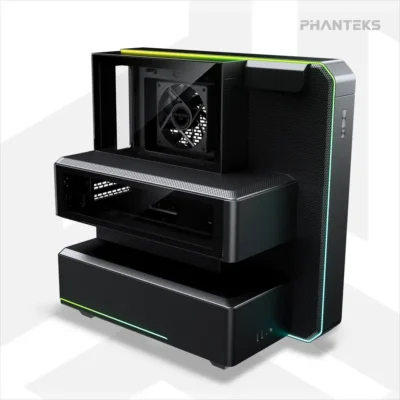
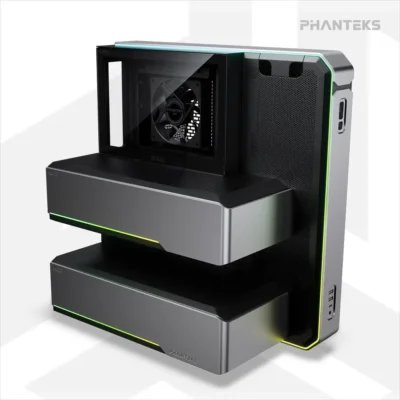
Phanteks’ EX-Series solves this with isolated airflow zones. Rather than one shared chamber, the case divides the interior into dedicated compartments: one for the CPU cooling solution, one for the GPU, and one for the PSU. Fresh ambient air feeds directly into each zone independently rather than flowing through a shared path. The CPU gets non-recirculated cool air. The GPU gets non-recirculated cool air. The PSU gets non-recirculated cool air. None of them are breathing what the others are exhausting.
A side-mounted fan handles the motherboard, VRMs, and M.2 storage separately. This is the zone that generates less heat than the primary components and benefits from targeted rather than bulk airflow.
The pitch is compelling: you can cool a serious high-end system without filling the case with six or eight fans because each critical component has its own dedicated fresh air supply rather than competing for shared airflow.
Whether independent testing confirms this thermal architecture performs as well as the theory suggests won’t be known until review units ship in September. The FPS Review’s preview called it “a legitimate departure from how most PC cases work” and worth watching closely. TechPowerUp’s community thread was more sceptical; one commenter asked directly what happens to thermals inside a compartmentalised system where heat has less room to dissipate. Both reactions are honest responses to a design that hasn’t been benchmarked independently yet.
EX6: $159.99, September 2026
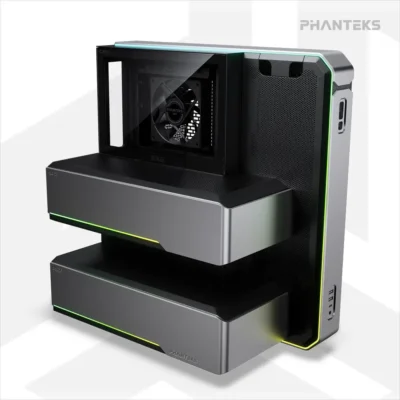
The standard EX6 arrives in September in a Stone Gray finish at $159.99 with steel construction throughout. The compartmentalised layout is meant for current high-end hardware: large GPU clearance for triple-fan RTX 5090-class cards, 360mm AIO radiator support, and a standard ATX motherboard form factor.
The single side-mounted fan configuration is the most debated aspect of the design. Conventional wisdom says more fans equals better airflow. The EX6’s architecture argues that directed fresh air per component zone outperforms undirected bulk airflow from multiple fans, the same logic behind point-source ventilation in building design. One well-positioned fan per zone moving fresh air directly at the target may outperform three fans sharing a common airflow path. For cases built around the conventional approach, see our best PC cases for airflow.
At $159.99 the phanteks ex6 2026 enters a competitive price tier. The Fractal Torrent at $184-$249 is the incumbent thermal performance benchmark. The Lian Li Lancool 207 at $82 is the established budget airflow leader. The EX6 has to demonstrate a meaningful thermal advantage over both to justify its position, particularly given that the Lancool 207’s dual 160mm bottom intake fans have consistently posted some of the strongest GPU temperature results in the market at less than half the EX6’s price.
EX6 Max: $329.99, September 2026
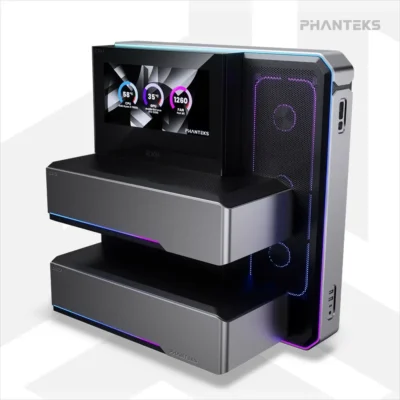
The EX6 Max is a significantly different proposition. At $329.99 it’s nearly double the standard model’s price and adds three premium features that define the upgrade.
Premium X30 fans throughout: Phanteks’ flagship fan units rather than the usual included fans. The X30 series is the company’s highest-performance thermal and acoustic product, and including them in the box rather than asking buyers to source their own is a genuine value inclusion at this price point.
A custom 90-degree AIO liquid cooler. Phanteks engineered a purpose-built AIO for the EX6 Max’s compartmentalised layout: a cooler that sits in the CPU zone at a 90-degree orientation relative to standard AIO mounting. This isn’t an off-the-shelf unit dropped in; it’s designed around the specific thermal geometry of the case interior. Whether this delivers better CPU temperatures than a standard 360mm AIO in a conventional case will be the central question for September reviews.
An integrated 10-inch 1600×720 LCD panel. Positioned for visibility through the case’s design, it connects to the integrated Nexlinq controller for real-time system monitoring CPU temperature, GPU temperature, clock speeds, fan speeds, and custom image and animation display. The Nexlinq controller also handles centralised ARGB fan management. For another flagship case packed with built-in features, read our MSI MEG MAESTRO 900R review.
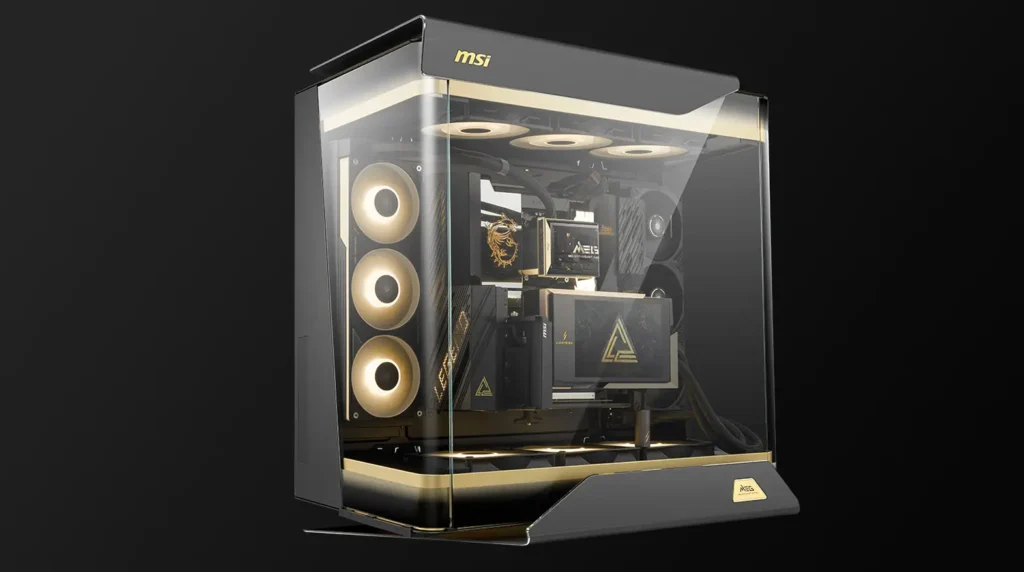
At $329.99 the EX6 Max is competing with the MSI MEG MAESTRO 900R at $699 in terms of showcasing ambition, while sitting below it on price. It’s not competing on the same raw scale (the MAESTRO 900R’s 33kg aluminium chassis is in a different category), but the EX6 Max’s integrated AIO, LCD, and premium fan package is a more complete out-of-box build experience than almost anything at this price.
What to watch for in September reviews
Three specific questions matter when independent benchmarks arrive.
First: does the compartmentalised airflow deliver measurably better temperatures than the Fractal Torrent or Lian Li Lancool 207 at comparable noise levels? If the architecture’s thermal theory translates to benchmark results, the EX6 earns its price. If a $80 Lancool 207 with its bottom intakes matches or beats the EX6’s GPU temperatures, the design philosophy is interesting but the value case is weaker.
Second: does the EX6 Max’s custom 90-degree AIO perform competitively against standalone 360mm AIOs from Arctic, Corsair, and Noctua? A purpose-built AIO optimised for its case geometry could outperform generic alternatives. It could also underperform premium standalone units.
Third: how does the integrated Nexlinq LCD and controller work in practice? An integrated monitoring display that requires proprietary software and creates ecosystem lock-in is a different product from one that integrates cleanly with existing iCUE, Armoury Crate, or third-party monitoring setups.
The Phanteks EX Series context: where these fit
SpecClear’s existing EX5, EX6, and XT M5 article covers the current generation. The EX6 launching in September is the next generation: a different product with a different architecture, not a quiet refresh of the EX6 covered in that article. Both pieces can sit side by side. The older article covers what’s already shipping; this one covers the September generation. That EX5, EX6 and XT M5 article is still the one to read for cases you can buy today.
If you’re building right now and the EX Series architecture appeals to you, the existing EX5 at $109.99 or EX6 at the current price are the correct current-generation options. If you can wait through the September launch window and independent reviews confirm the thermal claims, the new generation may be a real step forward.