
SpecClear earns a commission if you buy through Newegg links on this page, at no extra cost to you.

Samsung was once the undisputed king of consumer NVMe performance. The 970 Pro, the 980 Pro, the 990 Pro, each generation sat at or near the top of every benchmark chart. Then Phison’s E18 and E26 controllers arrived and pushed Samsung to second place for a stretch. The 9100 Pro is Samsung’s answer built on its own in-house Presto PCIe 5.0 controller, and it’s the fastest NVMe SSD tested to date in sequential throughput benchmarks. The caveat that comes alongside that title is worth understanding before spending around $400 on a 2TB drive though. Check current stock of the 2TB Samsung 9100 Pro ($399).
Specifications
The Samsung 9100 Pro is a PCIe 5.0 x4 NVMe 2.0 drive available in the standard 2280 form factor, 22mm wide and 80mm long, in capacities of 1TB, 2TB, 4TB and 8TB. Listed specs reach up to 14.8GB/s sequential read and 13.4GB/s write with up to 2.2 million read IOPS and 2.6 million write IOPS. Samsung uses its own in-house Presto PCIe 5.0 NVMe SSD controller, built on Samsung’s own 5nm process node, making it the most efficient controller of its kind currently in circulation. Samsung used DRAM cache on this model, with 1GB of LPDDR4X per TB of 236-layer TLC V8 NAND.As of September 2026, street pricing commonly lands around $249.99 for 1TB and $399.99 for 2TB at major US retailers, with deeper deals sometimes nearer $220 / $360. 4TB listings cluster roughly $994–$1,150. Launch MSRPs are long gone; buy on street, not nostalgia. Samsung 9100 Pro ($249)

Performance: genuinely fastest in synthetic benchmarks
The 4TB 9100 Pro aced all synthetic benchmarks in terms of sequential throughput and tests on CrystalDiskMark 8, AS SSD 2.0 and ATTO Disk all placed it easily in first place. It easily outstripped its PCIe 4.0 990 Pro predecessor in all aspects.
Those figures make it approximately twice as fast as a premium PCIe 4.0 SSD in ideal sequential benchmarks. That’s a real number, sequential reads of 14.8GB/s compared to roughly 7GB/s for a fast PCIe 4.0 drive. On paper it’s a massive leap. ComputerCritique covers the 4TB model in its 9100 Pro review.
Once the buffer is exhausted the write performance can taper off, but on the 4TB drive, the SLC cache is flushed fast enough to maintain strong write performance across the entire capacity of the drive. Unless you’re constantly writing massive files from a source faster than the 9100 Pro, you’re not likely to bump into the TurboWrite 2.0 buffer size anytime soon.
Thermal performance: the genuine surprise
Every other PCIe 5.0 controller released before this one ran hot. Some got hot enough that motherboards would thermally throttle the drive without a heatsink. What the 9100 Pro delivers alongside the speed is good thermal performance, because every other Gen 5 controller has run hot. The 9100 Pro delivers up to 49% enhanced power efficiency compared to its predecessor. this is substantial and should not be overlooked, there is very little point in having a very fast drive that gets throttled constantly due to heat.
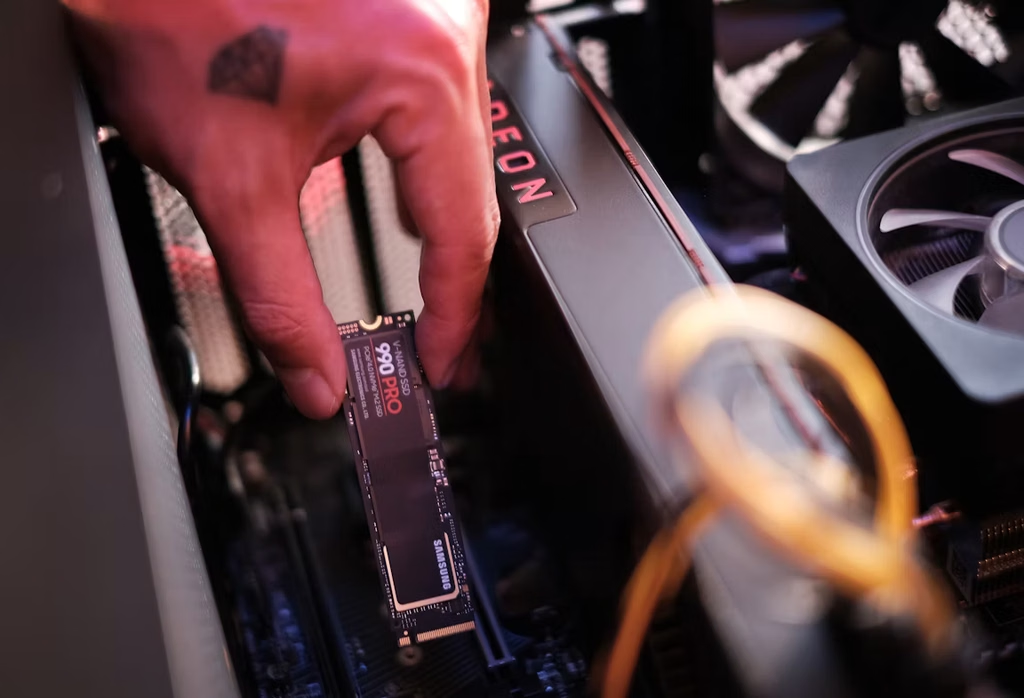
A drive that runs cool enough not to throttle under sustained workloads maintains its rated speeds where others back off. For anyone doing large sequential transfers like video editing, AI dataset work, large game installs the thermal stability is worth more than peak spec sheet speeds.
The honest gaming caveat
The Samsung 9100 PRO 4TB is an exceptionally fast and well-equipped PCIe 5.0 SSD, but most gaming and everyday computers cannot make full use of it. Samsung 9100 Pro (~$1,150)

Games load from storage sequentially, but modern game engines combined with Direct Storage mean load times are increasingly bottlenecked by decompression speed and VRAM throughput rather than raw SSD read speed. The 9100 Pro’s 14.8GB/s sequential read is roughly double as fast as a PCIe 4.0 drive. In real-world game load testing, the improvement is typically 5-20% depending on the title, not the 2x implied by the raw spec.so keep that in mind if you are looking at purchasing one of these for your gaming rig.

The practical position is a Samsung 990 Pro or WD Black SN850X running PCIe 4.0 at 7GB/s will load Cyberpunk 2077 or Hogwarts Legacy within a few seconds of the 9100 Pro. You won’t feel the difference during a gaming session. You will feel the difference if you’re regularly moving large video files, extracting archives or running AI workloads where sustained sequential throughput is genuinely the constraint.


Who needs this drive
In the right system with the right software, the 9100 Pro will run rings around the competition. The buyers for whom this is unambiguously the correct choice:
Video editors and content creators working with 4K or 8K footage. Moving 100GB+ project files from one location to another at 14GB/s versus 7GB/s is a difference you’ll measure in real minutes per session.

AI and machine learning users working with large datasets. Training runs that involve loading large model weights benefit directly from sequential read speed.
Builders who want the best available and aren’t primarily concerned with the cost-per-performance ratio. The 9100 Pro is the fastest drive that exists. If that’s the requirement, this is the answer.
Who should buy the 990 Pro instead
For Pure gaming builds The WD Black SN850X and Samsung 990 Pro at PCIe 4.0 are the correct drives for a gaming-only system. 4TB PCIe 4.0 SSDs are available for around half what the 9100 Pro costs. That money buys more storage, a better GPU, a higher-quality cooler or additional RAM, all of which affect gaming performance more than PCIe 5.0 SSD speed. If you do want PCIe 5.0 speed anyway, here is the Samsung 9100 Pro 2TB ($399).


PCIe 5.0 compatibility check
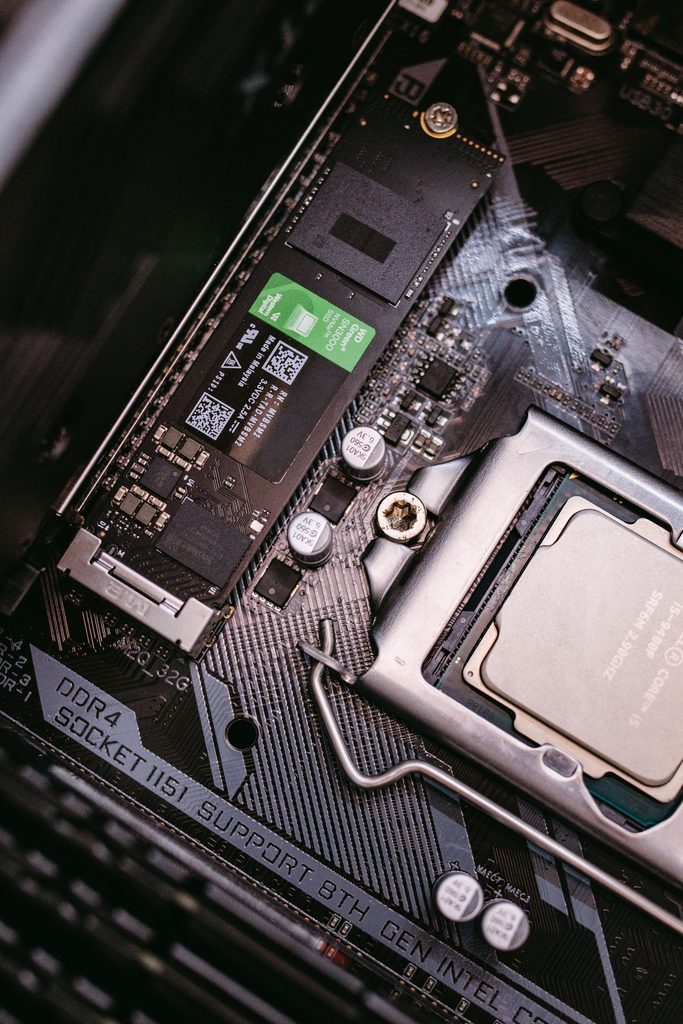
Before buying, confirm your motherboard has a PCIe 5.0 M.2 slot. The drive is available in bare or heatsink configurations. If your board has a PCIe 5.0 M.2 slot without an integrated heatsink, the heatsink variant is worth the extra cost given the drive’s thermal output under sustained workloads. All current-generation AM5 and LGA1851 motherboards with X870E, X870, Z890 or B860 chipsets have at least one PCIe 5.0 M.2 slot. Older platforms may not.
Encryption and software
The drive supports AES 256-bit full disk encryption and is TCG/Opal 2.0 and Encrypted Drive (IEEE1667) compatible. Samsung Magician software handles health monitoring, performance optimisation and firmware updates, it’s one of the better drive management utilities available and a genuine reason to lean toward Samsung if you run multiple Samsung SSDs.

The verdict
The Samsung 9100 Pro is the fastest drive tested, but it’s not a clear-cut winner in every category, which makes it harder to place. There will always be enthusiasts who will buy this on brand recognition alone, and that’s fine. What wasn’t expected was good thermal performance alongside the speed, this was a nice surprise in the right direction for a change. For a gaming-focused build, the 990 Pro or SN850X at half the price is the smarter choice. For creators and professionals who move large files daily, the 9100 Pro earns its premium straightforwardly, 14.8GB/s sequential read is a real-world benefit in those workflows in a way it simply isn’t in a gaming session.