
SpecClear earns a commission if you buy through Newegg links on this page, at no extra cost to you.
The Intel Arc B580 launched in December 2024 as the most interesting budget GPU story in years. 12GB of GDDR6 for around $290–$320 — more VRAM than any Nvidia or AMD card at that price, on a new architecture that actually performed. The PC building community, which had spent years dismissing Intel’s GPU ambitions, paid attention.
Seven months later the picture is more complicated. The card is still good. The price isn’t always what it was. And the competition has moved. Here’s where the Intel Arc B580 stands now.
What made it interesting at launch and what’s changed
The B580’s core case at launch was simple: 12GB GDDR6 at $291 at a time when Nvidia and AMD were selling 8GB cards in that price bracket. The VRAM advantage was real and meaningful 8GB cards were already showing strain in texture-heavy modern titles at 1440p, and the B580’s larger buffer kept it clear of that ceiling.
That case hasn’t weakened. What’s changed is price and competition.
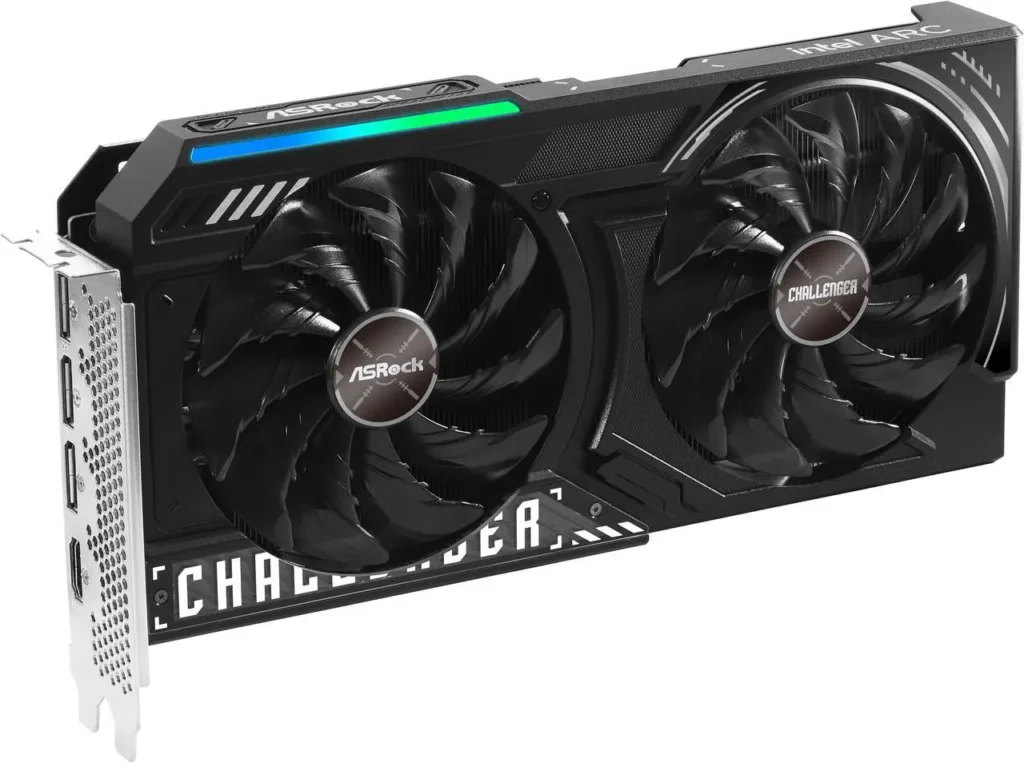
Street pricing in July 2026 puts the B580 at ~~$290–$320 on Amazon. Newegg occasionally stocks the Intel Limited Edition at the $249 MSRP but it sells out quickly when it appears. The OC variants from ASRock, Acer, and Sparkle sit at $260–$280 when available. The card launched with serious supply problems it was effectively a paper launch for the first several months and while availability has normalised, price has not fully returned to MSRP across all retailers.
The RTX 5060 launched at $329 with 8GB. The RX 9060 XT launched at $349 with 16GB. The RTX 5060 Ti 8GB sits at ~~$290–$320. At these new reference points, the B580 at ~$290–$320 occupies a different position than it did at $249 against the RTX 4060 and RX 7600.
The gaming performance — honest numbers
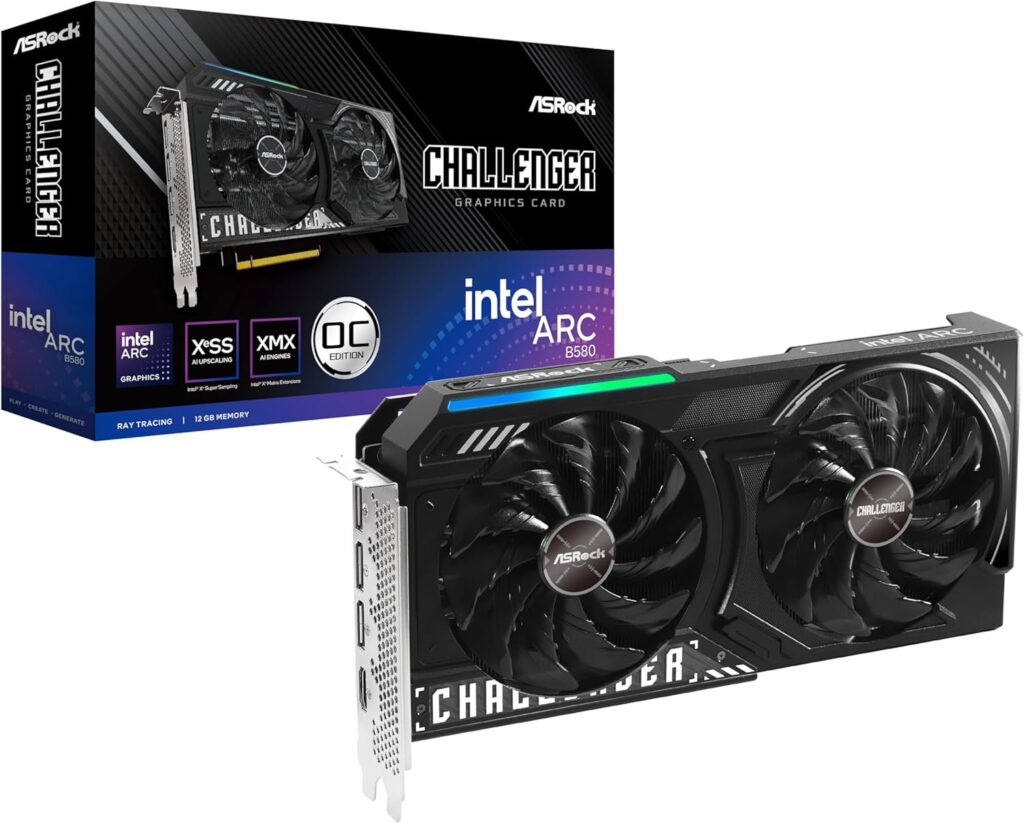
At 1080p the B580 trades blows with the RTX 5060. Multiple benchmark sites across 100+ games show the B580 roughly 5–7% faster than the RTX 5060 on average a counterintuitive result given the B580’s older architecture, but explained by the wider 192-bit memory bus giving Intel’s card meaningfully more memory bandwidth than the RTX 5060’s 128-bit GDDR7 configuration. The RTX 5060 wins comfortably in raw shader performance and compute throughput. The B580 wins on bandwidth-sensitive workloads, which covers a significant portion of rasterised gaming.
At 1440p the B580 holds its own against the RTX 5060 and begins to pull ahead in titles where the 12GB VRAM buffer matters Black Myth: Wukong at max textures, Indiana Jones, Monster Hunter Wilds. These are games where an 8GB card visibly stutters during asset streaming and the B580 continues without complaint.
Ray tracing is the B580’s genuine weakness. Intel’s Xe2 RT hardware competes with AMD’s RDNA 3 generation which is to say it’s functional in light RT scenarios but falls apart in demanding workloads. Cyberpunk 2077 with RT Overdrive enabled at 1080p drops to roughly 28 FPS on the B580 playable only with XeSS engaged. The RTX 5060 with DLSS 4 handles the same scenario materially better. If ray tracing is a regular part of your gaming, the B580 is the wrong card.
The Resizable BAR requirement read this before buying
The B580 requires Resizable BAR to be enabled in your BIOS to deliver its rated performance. Without it, performance drops 15–25% in many titles. Resizable BAR is supported on essentially all modern platforms any Ryzen 3000 series or newer CPU on an AM4 or AM5 board, any Intel 10th gen or newer CPU on a compatible board. But it must be enabled. It doesn’t activate by default on every system.
Check your BIOS for SAM (AMD) or Resizable BAR (Intel) and enable it before installing the B580. If you’re on a very old platform that doesn’t support it, that’s a real problem the performance penalty is not something you tune around.
The driver situation genuinely better but not finished
Intel’s Arc driver journey has been one of the more remarkable software rehabilitation stories in GPU history. The A-series launch in 2022 was a driver disaster DX9 games crashed, performance was unpredictable, and the whole experience felt like a beta product. Battlemage launched into a significantly more mature driver stack and it shows.
In 2026 the B580’s drivers handle the overwhelming majority of modern titles without issues. The remaining rough edges are concentrated in older titles DX9 and DX11 games occasionally show compatibility problems or performance anomalies that Nvidia and AMD don’t. If your gaming library is predominantly recent releases from the last three or four years, the driver situation is fine. If you play a lot of older titles, check them on ProtonDB or Intel’s compatibility list before buying. Intel is also no longer the only newcomer with certified drivers. China’s Lisuan LX 7G100 has WHQL-certified Windows drivers too, although it isn’t a realistic buy outside China yet.
One important flag for AMD Ryzen users specifically: the B580 does not have any CPU brand restrictions it works identically on Intel and AMD platforms but some early reports of instability on Ryzen systems were driver-related and largely resolved in 2025 driver updates. If you’re on a Ryzen build, ensure drivers are current before doing any troubleshooting.
XeSS — better than it was, still behind DLSS 4
Intel’s XeSS upscaling has improved significantly since launch. XeSS 2 with frame generation is available on B580 and delivers competitive image quality at Quality mode compared to FSR 4. It’s a genuine upscaling option rather than a compromise.
The ceiling is lower than DLSS 4 Multi Frame Generation. XeSS supports one generated frame per rendered frame; DLSS 4 generates up to three. For competitive gaming on a 144Hz panel that gap matters less than it sounds both deliver frame rates well above 60 FPS in most titles. For high-refresh gaming on a 240Hz+ panel, DLSS 4’s ceiling is meaningfully higher.
Who should actually buy it
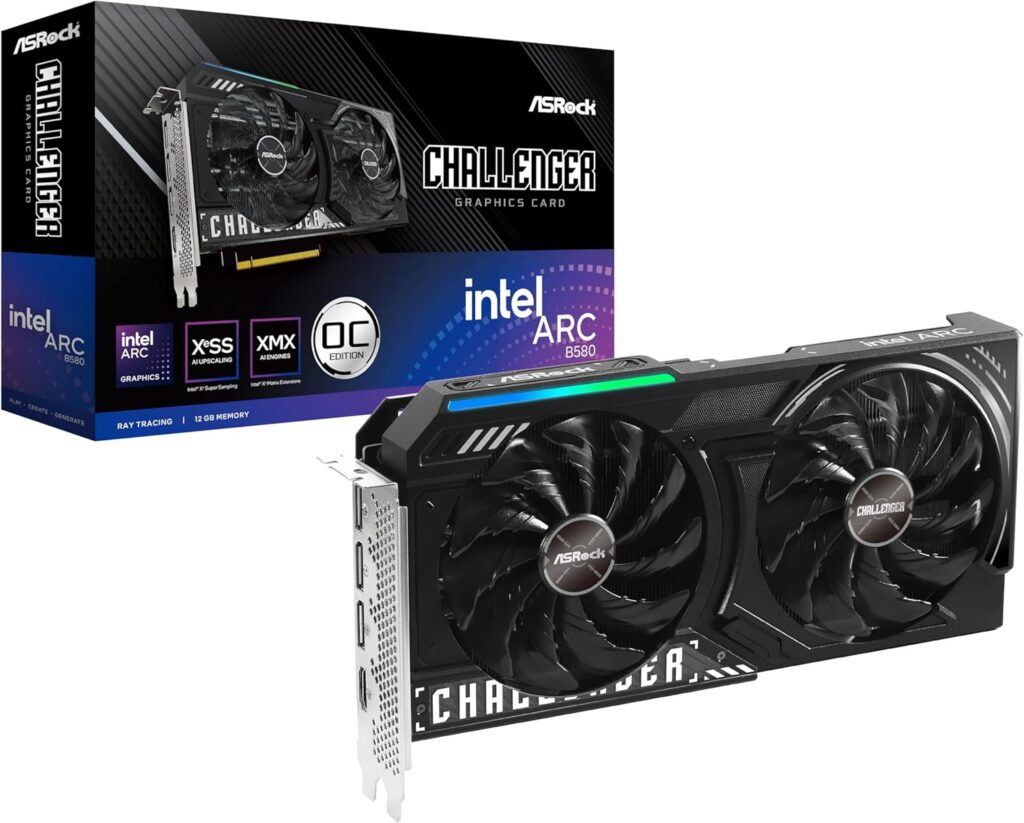
The B580 at $309 on Newegg when it’s in stock is a compelling buy. 12GB VRAM, competitive raster performance at 1080p and 1440p, a significantly improved driver stack, and a VRAM advantage over every 8GB card in the same price range. If you find it at $249, it’s the correct card at that price for 1080p-focused builders who don’t prioritise ray tracing.
At $299–$303 on Amazon the calculus is tighter. You’re now $50 below the RTX 5060 at $329, which has 8GB but DLSS 4 and better ray tracing. You’re $50 below the RTX 5060 Ti 8GB at $364-$390. The VRAM advantage of the B580 remains real, but the premium for the RTX 5060 Ti 16GB at $564–$759 starts looking reasonable 16GB with better shader performance versus 12GB with better bang per dollar.
Don’t buy the B580 if: ray tracing is a regular part of your gaming, you have a large library of older DX9 or DX11 titles, or you’re gaming at 1440p with heavy RT in demanding 2026 titles. Do buy it if: you’ve found it near MSRP, you game primarily in modern rasterised titles at 1080p or light 1440p, and the 12GB VRAM buffer matters more to you than DLSS 4 access.
The competitive summary
At $291 the B580 beats the RTX 5060 on value At $349-$390 it trades blows with the RTX 5060 depending on your priorities. At $299-$390 the RTX 5060’s street price the two cards are within each other’s error margins on overall value and the Nvidia ecosystem advantages start tipping the scales. The B580’s window is narrow but real.
Watch Newegg for restocks at $249. That’s the price at which this card’s case is clearest. Don’t pay more than $280 for any B580 variant.