
Air cooling hasn’t had a genuinely interesting moment in years. The formula has been settled for a long time: two towers, six or eight heatpipes, two 140mm fans, done. Noctua NH-D15 at the top, a handful of competitors clustered around it, and nothing that challenges the fundamental architecture.
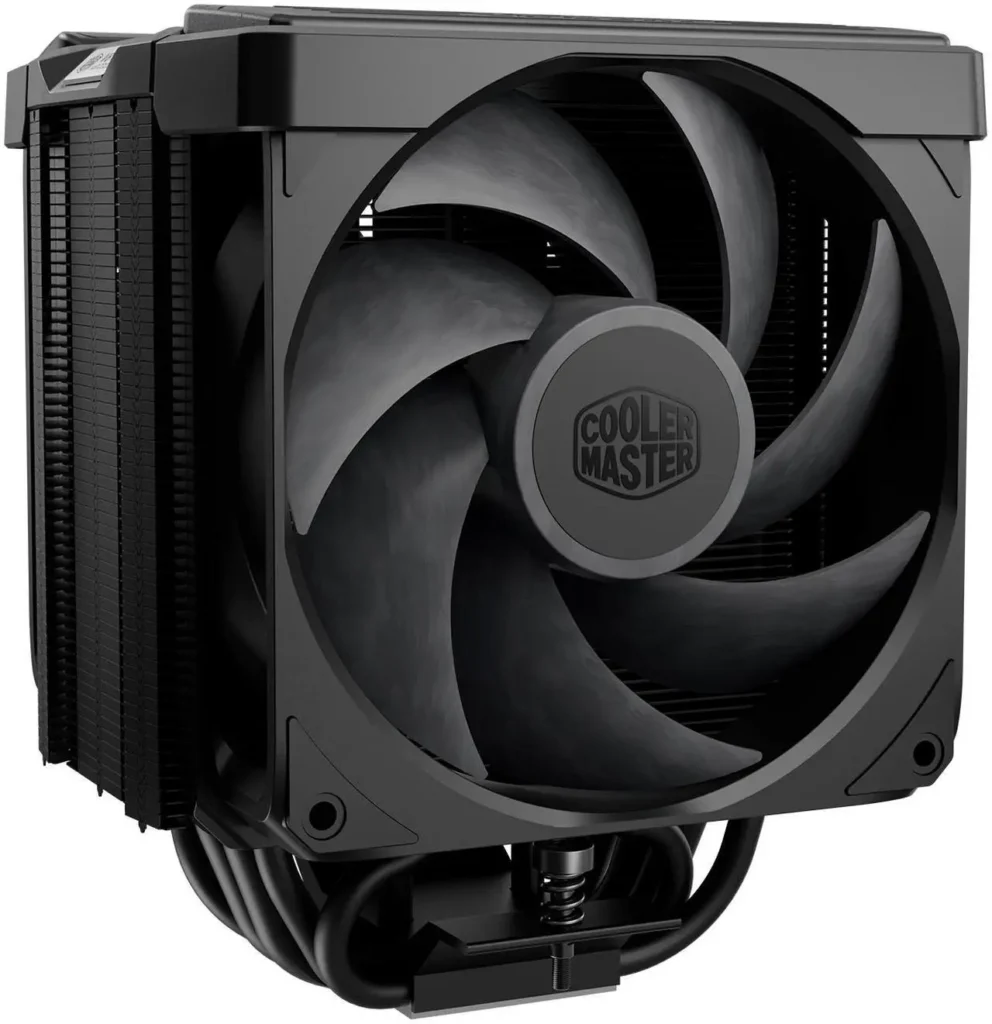
The V8 ACE 3DHP challenges it. Not by going bigger, it’s a single tower. It challenges it by redesigning the heatpipe itself. Cooler Master calls the technology 3DHP, and the results from independent testing are genuine enough that this is the first air cooler in several years worth paying attention to as something new rather than a variation on an existing theme.
Whether it’s worth $119.99 is a different question. Let’s get through what it is first.Cooler Master V8 ACE 3DHP ($119)
What 3DHP Actually Means
Standard CPU heatpipes are U-shaped. One end sits in the copper base plate absorbing heat from the CPU. The pipe runs up through the fin stack. The other end sits at the top, where heat dissipates through the fins into the air moving through them. The physics are well understood and the design works well, but it has a limitation. The fins at the extreme top and bottom of the heatsink, furthest from where the heatpipes contact the fin material, transfer less heat than the fins in the middle. The fin stack isn’t being used as efficiently as it could be.be quiet! Dark Rock 6 and Pro 6 Review
Cooler Master’s 3DHP pipes are trident-shaped rather than U-shaped. Three ends rather than two. The base end absorbs heat from the CPU as normal. One upper end runs to the top of the heatsink. The second upper end branches back down toward the middle of the fin stack, feeding heat directly into the centre of the fins rather than relying on conduction through the aluminium to get there. The result is better heat distribution across the full height of the fin stack. Cooler Master claims roughly 100% fin utilisation versus approximately 70% with conventional heatpipes.Air Cooler vs AIO CPU Cooler 2026
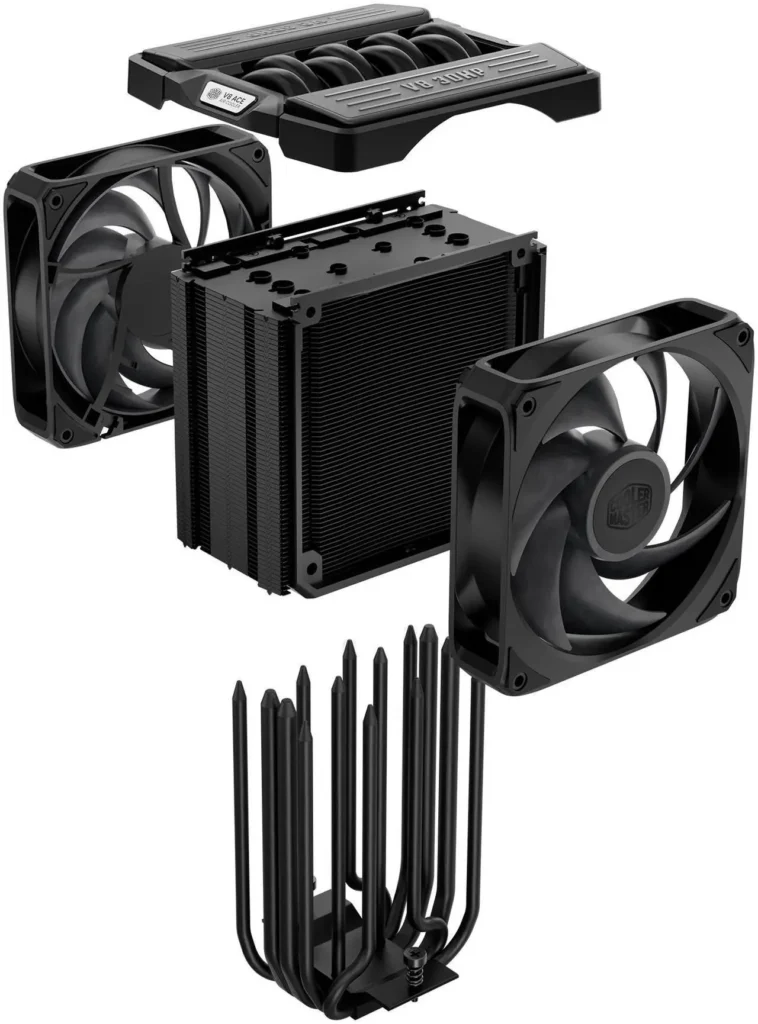
The V8 ACE 3DHP uses two of these trident pipes alongside four conventional heatpipes in a hybrid configuration. The 3DHP pipes handle the critical centre-to-middle-of-fins path. The conventional heatpipes supplement lateral heat spreading. Combined with a nickel-plated copper base machined to different specifications for the AMD and Intel versions, the thermal pathway from CPU die to fin surface is genuinely more efficient than a conventional single-tower design of comparable size.
Cybenetics, the independent hardware testing laboratory that benchmarks coolers under standardised methodology, placed the V8 ACE 3DHP AMD version first among all single-tower air coolers in their database and second overall among all tested air coolers, including dual-tower designs. The Intel version performs similarly. That’s not marketing. It’s third-party data from an organisation with no commercial relationship with Cooler Master.
Build Quality and Design
The V8 ACE is visually distinctive in a way that divides opinion. The design references the visual language of high-performance engines, angular, industrial, with a carbon-fibre effect top panel that’s either impressive or too much depending on your build aesthetic. It won’t fit in a minimal white build. It looks at home in a dark performance build.
The dimensions are 138.95 × 136.47 × 167.3mm at 1,020g, heavier than most single-tower coolers. At 167.3mm height it’s taller than the Noctua NH-U12A (158mm) and requires a case that clears at least 170-175mm for comfortable installation with fan cables accounted for. Check your case’s CPU cooler clearance spec before buying. Most standard ATX mid-towers clear 160mm minimum, the V8 ACE fits most of them, but it’s tighter than shorter coolers.Cooler Master V8 ACE 3DHP ($119)

The fan mounting system is genuinely well thought out. The two 120×30mm fans slide off their clips using a simple pull mechanism, no screwdriver required, and that matters more than it sounds. On a fully built system, removing a 140mm or 120mm fan to access RAM slots that are blocked by the cooler’s overhang usually means fiddling with spring-loaded clips while your hands are inside a case. Cooler Master’s sliding mount removes both fans in ten seconds. RAM access is simple.Noctua NH-U12A ($262)
Two fans are included in the box: a front fan rated to 2500 RPM pushing 89.6 CFM at 3.85 mmH₂O static pressure, and a rear fan rated to 2050 RPM pushing 61.0 CFM at 2.0 mmH₂O. The front fan’s higher static pressure is deliberate, it forces air into the dense fin stack against resistance. The rear fan assists exhaust without generating unnecessary noise. The asymmetric fan specification is correct engineering rather than cost-cutting. Loop Dynamic Bearings and LCP (Liquid Crystal Polymer) blades give both fans a rated lifespan of over 200,000 hours. The six-year warranty backs that claim with something enforceable.
Intel and AMD versions use the same heatsink and fans but differ in meaningful ways. The AMD version uses a lower working fluid volume optimised for AMD’s heat density characteristics and hotspot distribution, Ryzen chips concentrate heat in a small die area. The Intel version contains more working fluid to handle Intel’s higher sustained power draw and sharper thermal spikes. Both versions also use platform-specific mounting pressure and contact positioning. Buying the wrong version isn’t just a mounting inconvenience, it means suboptimal thermal performance on your platform. Select carefully at checkout.Noctua NL-LC1 AIO Review
Thermal Performance: The Numbers That Matter
At full load on AMD platforms, the V8 ACE 3DHP handles the Ryzen 9 9950X3D at sustained gaming workloads with CPU junction temperatures staying consistently under 85°C, competitive with the Noctua NH-D15 G2 and outperforming it in noise-normalised testing on AMD hardware specifically. The test result Hardware Busters calls out explicitly: at the same noise level, the V8 ACE 3DHP AMD outperforms the Noctua NH-D15 G2 in their AMD testing. That’s the dual-tower benchmark it’s competing against.

For context on what that means in practice: the Noctua NH-D15 G2 is 165mm tall, uses two 150mm fans, weighs 1,480g, and has been the reference point for best-in-class air cooling for years. The V8 ACE is a single tower, uses two 120mm fans, weighs 1,020g, and on AMD platforms matches or beats it at equivalent noise levels. The size, weight, and footprint advantages are real. The price differential (NH-D15 G2 runs $110-$120, V8 ACE runs $119.99) essentially eliminates cost as a differentiator.How to Monitor GPU and CPU Temperatures
On Intel platforms the picture is slightly different. The V8 ACE Intel version performs at the top of the single-tower category and trades blows with large dual-tower designs but doesn’t consistently beat the NH-D15 G2 on Intel hardware the same way it does on AMD. Intel’s higher sustained power targets and different heat density mean large dual-tower coolers retain a performance edge on high-TDP Intel chips under sustained all-core workloads. For gaming on Intel, where sustained all-core loads are rare and burst performance matters more, the V8 ACE handles every current Intel desktop CPU without throttling.
Noise at gaming load is where the V8 ACE earns real praise. At the fan speeds required to maintain gaming-level CPU temperatures, typically 40-60% of maximum RPM, both fans are effectively inaudible at normal viewing distances. The Loop Dynamic Bearing mechanism produces no ticking, grinding, or whine. At maximum RPM the front fan reaches 37 dBA and the rear 34 dBA, audible, but never harsh. Custom fan curves in your BIOS that cap both fans at 1500 RPM produce near-silent operation with temperatures that remain well within safe limits on any current gaming chip.
Who Should Buy It and Who Shouldn’t
Buy the V8 ACE 3DHP AMD version if: you’re building on AM5 with a high-TDP chip (9950X3D, 9900X3D, 9950X) and want best-in-class single-tower performance with significantly less motherboard and RAM clearance impact than a dual-tower design. The 3DHP technology’s advantage on AMD hardware is well validated across multiple independent sources.
Buy the V8 ACE 3DHP Intel version if: you’re building on LGA1851 with a gaming-focused workload and want an aesthetically distinctive, high-performance cooler that doesn’t dominate the interior of your case the way an NH-D15 G2 or DeepCool Assassin IV does.How to Apply Thermal Paste to Your CPU
Don’t buy it if: your case CPU cooler clearance is under 170mm. The V8 ACE is 167.3mm without fan cables and mounting hardware, real-world clearance needed is closer to 175mm. Check your case spec before purchasing.
Don’t buy it if: you’re cooling a chip under 125W TDP and primarily care about value. A Noctua NH-U12S Redux at $50 or an Arctic Freezer 36 at $35 both handle 65-125W chips effectively and cost less than half the V8 ACE’s price. The V8 ACE earns its price at the high end of the TDP range where the 3DHP technology’s advantage over conventional designs is most pronounced.
Don’t buy it if: the visual design doesn’t fit your build. No amount of performance data changes whether the industrial engine-aesthetic works for your aesthetic goals.
The Alternative: When to Choose Something Else
Noctua NH-D15 G2 (~$199): still the reference dual-tower benchmark. Better on high-TDP Intel chips under sustained all-core loads. Significantly larger and heavier. RAM compatibility can be an issue depending on heatspreader height. Buy this if you’re on Intel and regularly sustain all-core workloads.Noctua NH-D15 G2 ($262)

DeepCool Assassin IV (~$80): dual-tower, 175mm height, exceptional noise-normalised performance, cheaper than the V8 ACE. Buy this if performance per dollar is the priority and you don’t care about the V8 ACE’s more compact single-tower footprint.DeepCool Assassin IV

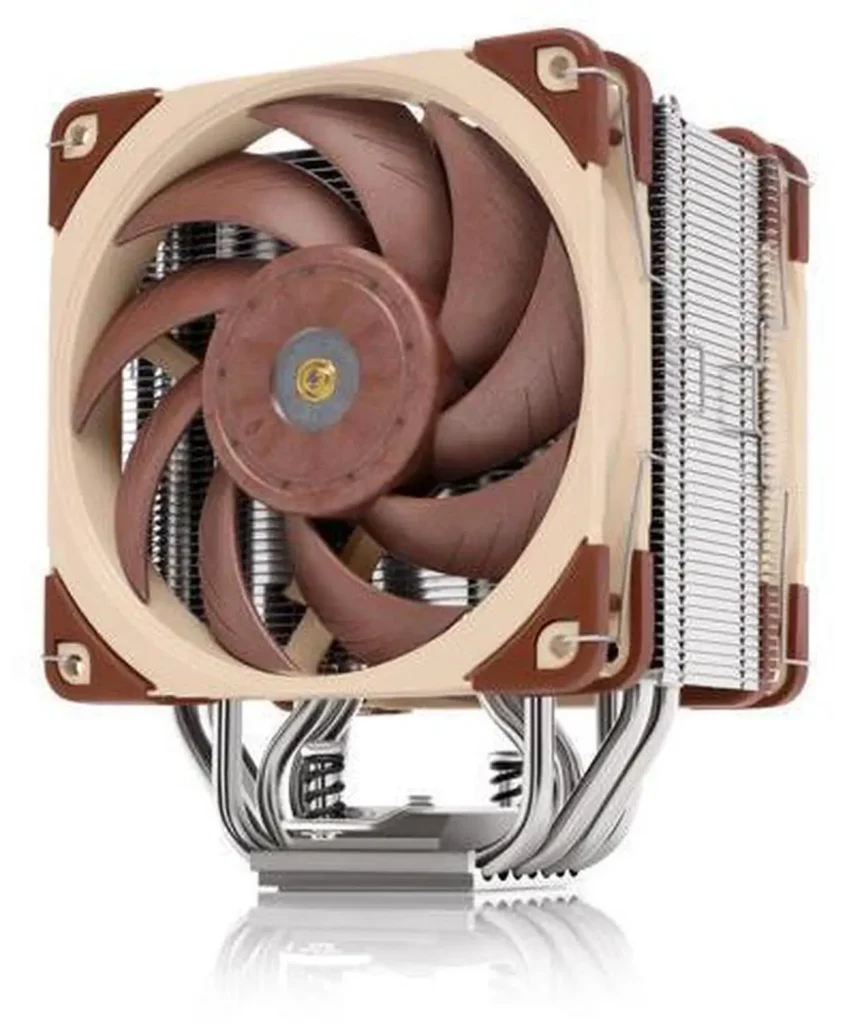
Noctua NH-U12A (~$117): single-tower, 158mm height, two 120mm fans, exceptional noise levels, proven reliability. Buy this if case clearance is tight (160-165mm), you want Noctua’s reliability track record, and the V8 ACE’s 3DHP advantage on your platform isn’t worth the extra $40.Noctua NH-U12A ($262)

Any 360mm AIO ($130-$200): significantly better sustained all-core performance on 200W+ chips like the 9950X3D and Core Ultra 9 285K. Quieter at sustained loads because the radiator surface area dissipates heat without needing fans at high RPM. More complex installation, more potential failure points over time. Buy an AIO if you’re running a flagship-tier chip and thermal performance is the priority over simplicity.

Verdict
The Cooler Master V8 ACE 3DHP is the most significant advancement in single-tower air cooler design in several years. The 3DHP heatpipe technology is real, independently validated, and produces measurably better heat distribution than conventional heatpipe designs at comparable sizes. On AMD AM5 hardware specifically it matches or beats the NH-D15 G2 in noise-normalised testing, a claim no single-tower cooler has been able to make convincingly until now.
At $119.99 it’s priced at the premium end of air cooling. The six-year warranty, LCP blades, Loop Dynamic Bearings, and platform-specific thermal tuning justify most of that premium. The sliding fan mount is one of the most practical innovations in recent cooler design and alone saves meaningful time during builds and upgrades.
It’s not the right choice for every build: cases with tight CPU clearance, budget-focused builds, or high-TDP Intel workstation chips all have better-matched alternatives. For AMD AM5 gaming builds with a mid-to-high TDP chip that need single-tower footprint with dual-tower performance, the V8 ACE 3DHP is the cooler to buy.
Specs
- Socket support: AM4/AM5 (AMD version), LGA1851/1700/1200/115x (Intel version)
- Heatpipes: 2× 3DHP trident pipes + 4× conventional heatpipes
- Base material: Nickel-plated copper
- Fans: 2× 120×30mm PWM (push-pull)
- Fan speed: Front 0-2500 RPM / Rear 0-2050 RPM
- Max airflow: Front 89.6 CFM / Rear 61.0 CFM
- Max noise: Front 37 dBA / Rear 34 dBA
- Fan bearing: Loop Dynamic Bearing (rated 200,000+ hours)
- Dimensions: 138.95 × 136.47 × 167.3mm
- Weight: 1,020g
- Warranty: 6 years
- Price: $119.99